An Even Match Is the Product

Somewhere this weekend, a team of eleven-year-olds will lose 9–0.
Nobody will have wanted it. It will happen because five weeks earlier a volunteer sat at a kitchen table at eleven at night, moved two teams into the same group because it was the only arrangement that fit the pitches, and went to bed. The schedule looked fine on paper. It took four evenings to build.
Twenty-two children will pay for that decision on Saturday morning. One team learns that football is humiliation. The other learns nothing at all.
A fixture list is not an administrative document
This is the thing we believe, and everything else about FairGame — including the price — follows from it.
The schedule is not the paperwork you get through so the tournament can start. It is the tournament. It decides who plays whom, how long a child sits in a cold car park between games, whether a team travelling two hours gets a 08:40 kick-off, and whether any given match is worth playing at all. Every one of those is settled weeks in advance, by a person, at a desk, usually late, usually tired, usually alone.
Most tournament software treats that person as a data-entry problem. Give them a grid, let them drag things around, congratulate them when nothing double-books. The software has no opinion about whether the weekend was any good, because it has no idea what good would mean.
We think that is a failure of nerve. The most consequential decision in youth sport is made by a volunteer with a spreadsheet, and we have collectively decided to help them with the formatting.
Our neighbours already wrote this down
We did not invent this position. We inherited it, and we are fairly shameless about where from.
Denmark. The DBU's guidance for children's football rests on a rule of thumb known as 25/50/25: roughly a quarter of the time a child should play opponents below their level, half the time opponents at their level, and a quarter of the time opponents above it. Not for the trophy — for the player. Their children's strategy goes further still: no championships below twelve, weekend tournaments in place of league competition, and a principle stated bluntly — the experience is in, the standings are out.
Norway. The barneidrettsbestemmelsene are binding provisions, not advice. Result lists, tables and rankings have no place in children's competition until the year a child turns eleven. Norwegian sport decided that a league table is a thing you can do to a nine-year-old, and that it would rather not.
Finland. Kaikki Pelaa — "Everyone Plays" — goes as far as reaching into the match itself when one side runs away with it, and guarantees each child real time on the pitch instead of a place on the bench. Finland concluded that if the game has stopped being a contest, the game should change.
Three federations. Three mechanisms. One conclusion, arrived at independently: the even match is the product. A 9–0 is not a good result for one team and a bad one for the other. It is a failed match for everyone on the pitch, and it was caused at a desk, in advance, by someone who had no way of seeing it coming.
Here is the part that has bothered us for years. Those federations wrote the values down. They published them, printed them, made some of them binding. And then they handed the organizer a spreadsheet.
You cannot implement 25/50/25 in Excel. You cannot ask a drag-and-drop grid whether this group is even. The ideology exists; the instrument does not. Every Nordic federation legislated a standard that the available software had no capacity to meet, and then left volunteers to meet it by hand, at eleven at night, with predictable results.
We built the instrument.
What that actually took
Not a feature list — the point of each part is the same point.
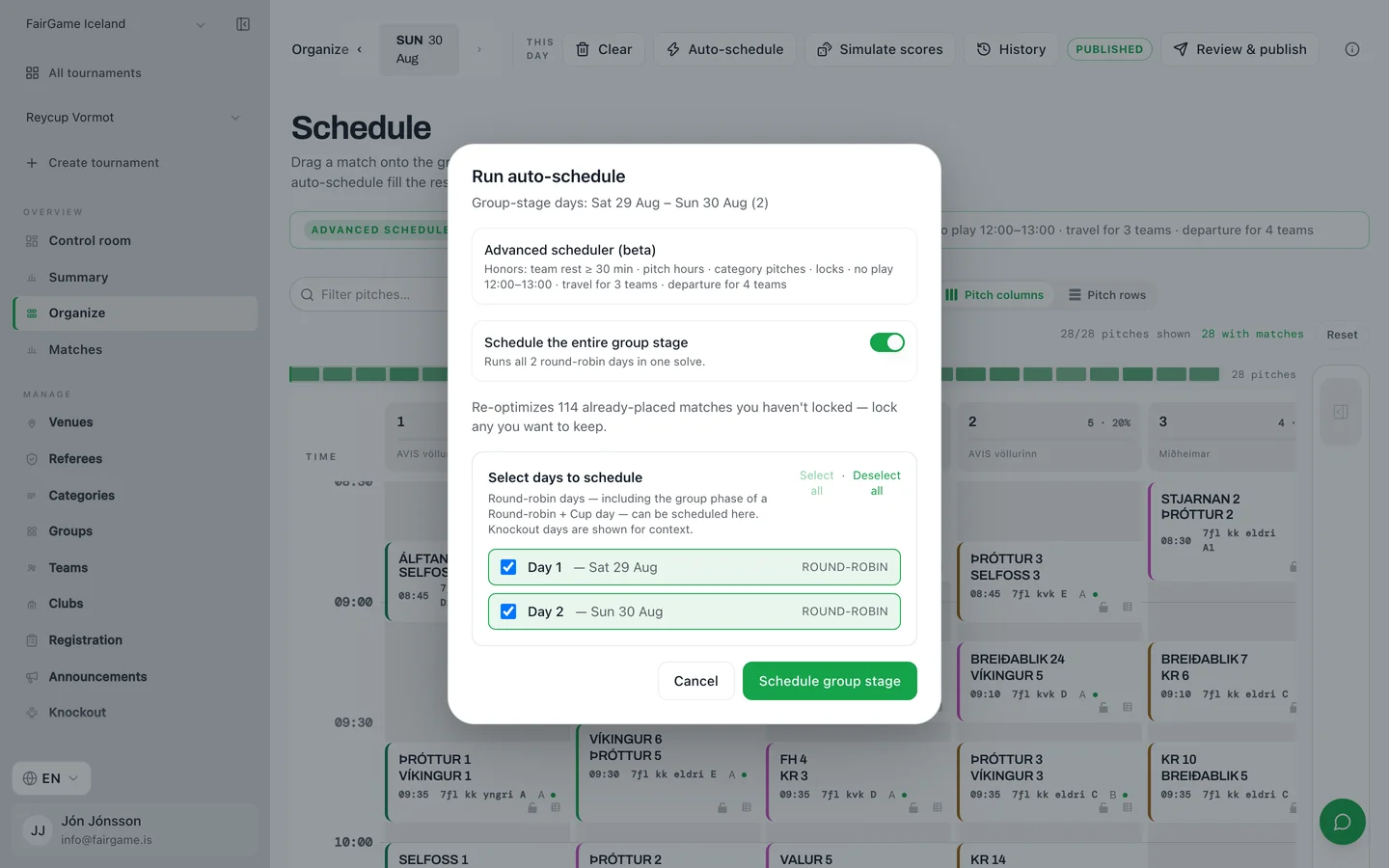
FairGame does not fill in a template. It models your tournament as a constraint problem and places every match under it. Some rules can never bend, so we never let you switch them off: no pitch hosts two matches at once, no team plays two at once. The rest are yours — a minimum rest gap between a team's games, when each pitch is actually open, which pitches an age group is allowed to use, a late start for the club driving in from Akureyri, the opening match and the final pinned exactly where you want them. And the wishes that fit no form — the youngest category done before lunch, both finals on the stadium pitch — go into a scheduling brief in your own words, and an AI architect plans the day around them, from the schedule the rules produced, with every schedule it proposes checked against those same rules before it reaches your board.
Then it optimises, and — this matters more than the optimisation — it tells you when your rules cannot all be honoured at once, and which of your wishes it kept and which it could not, instead of quietly producing a schedule that breaks one and letting you find out on Saturday.
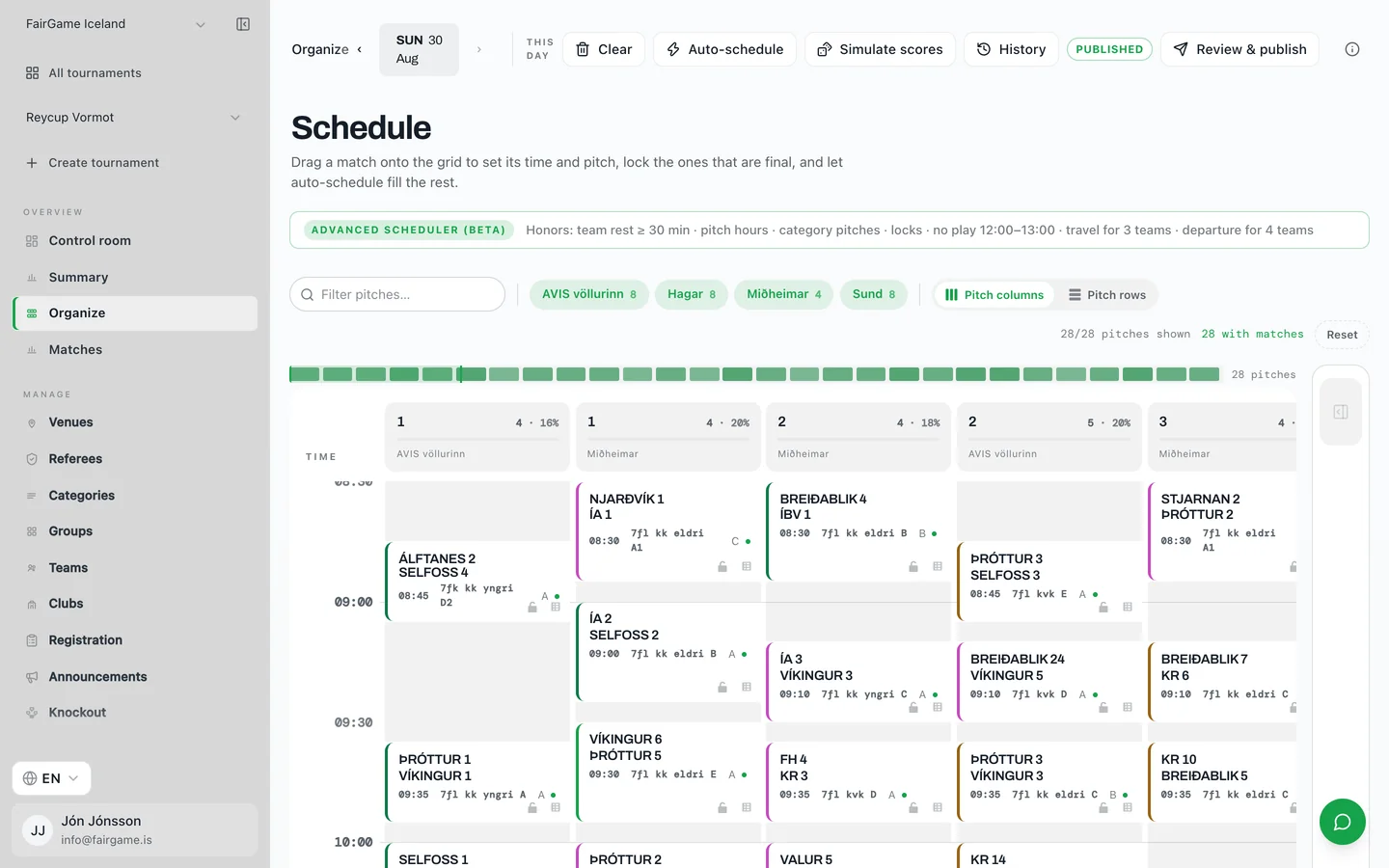
That handles the day. It does not, on its own, make the matches even — for that you have to know how good the teams actually are, and the number a club types into a registration form is a guess, sometimes a hopeful one.
So FairGame rates every team with OpenSkill and seeds groups and brackets from measured strength rather than self-assessment. When the tournament ends, it compares what each club registered against the level their team actually played at, and flags the ones that were two or more levels out — in both directions, because a team registered too strong has a miserable weekend and a team registered too weak ruins everyone else's. You send the club a courteous note. Next year they register honestly.
Those ratings persist. Every tournament you run makes the next draw better informed — yours and everyone else's on the platform. The unevenness compounds downward, year on year, which is the closest thing to 25/50/25 anyone has managed to build.
So: 1,200 kr. a team
Tournaments up to sixteen teams are free forever — the whole platform, not a crippled tier. Your first tournament is free at any size. Above sixteen, it is 1,200 kr. for each additional team, charged once, when you publish. A 24-team tournament costs 9,600 kr. A 48-team tournament costs 38,400 kr.
That is more than the alternatives charge. We know. We checked before we set it.
It is more because a constraint solver costs more to build and run than a template, because a rating system that spans tournaments is a system rather than a feature, and because the unglamorous half of this — referee coverage checks, ten languages, the audit trail on a schedule revision — is the half that decides whether your Sunday goes well, and nobody will fund it by demoing it.
We are not the only people who thought the idea was worth paying for. FairGame took second place at Gulleggið, Iceland's oldest startup competition, in 2024, and has since been backed by three grants from Rannís, the Icelandic Centre for Research — the Fræ grant after Gulleggið, the Sproti grant after we ran the platform live under real pressure at ReyCup 2024. Public research money, in a small country, went to a tool for making children's football fairer. We do not take that lightly, and it is why the answer to "could you do a cheaper version that just makes a grid" is no.
Everything is in the price. Referee scoring by QR code with no app and no login, the live public results page with your logo on it, the parent's follow-your-team view, the mobile apps, announcements to every coach, templates, the assistant, ten languages. There is no modern-interface upgrade and no per-module pricing, because a tournament that can only afford half the product is exactly the tournament that needed all of it.
The honest part
If you are running sixteen teams or fewer, you will never pay us anything, and you should just start.
If you have forty-eight teams and the only thing you are optimising is the invoice, we are the wrong choice, and we would rather tell you here than after you have imported your teams. There is cheaper software. It will produce a schedule. It will not have an opinion about whether the schedule was any good.
And if what you want is a weekend where the fixtures were decided on purpose — where a team that drove two hours does not kick off at 08:40, where the groups are even before a ball is kicked, and where no eleven-year-old goes home having lost 9–0 because of a decision made at a kitchen table at eleven at night — then it is 38,400 kr., and we think it is the best-value line in your budget.
An even match is the product. Everything else is logistics.
Read next