How to Schedule a Multi-Venue Tournament
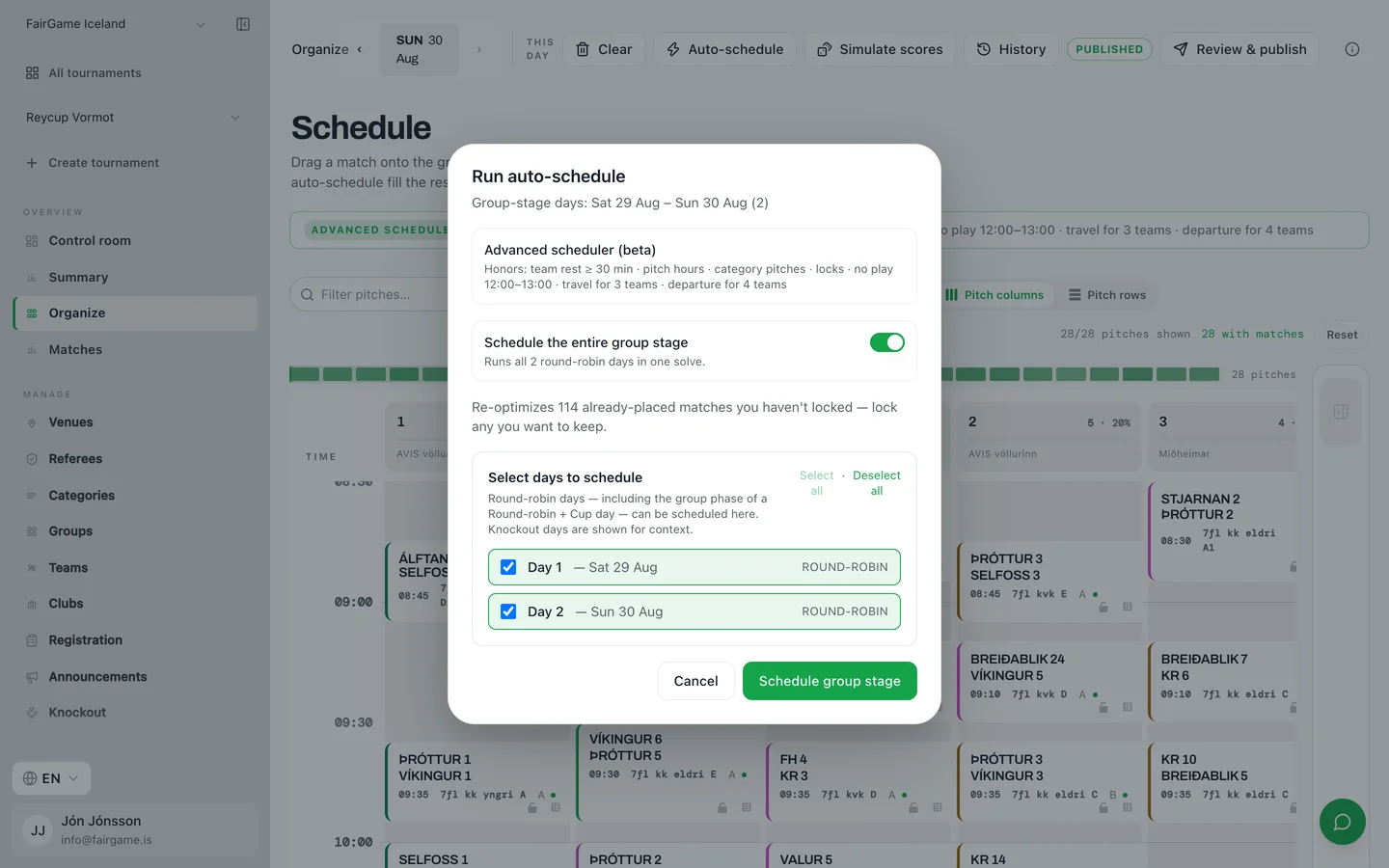
To schedule a tournament across multiple venues, first check the day fits at all — total pitch-minutes available against match-minutes required — then place fixtures so no team is ever booked in two places at once, and never expects a team to cross town between back-to-back matches.
The hard part is not the fixture list. It is the travel, the rest, and the fact that every constraint interacts with every other one.
Start with capacity, not the fixture list
The single most common failure is discovering on the Thursday that the day was never going to fit. Do the arithmetic first.
Add up your pitch-minutes: each pitch multiplied by the hours it is open. Then add up your match-minutes: total matches multiplied by match duration plus changeover. If the second number is anywhere near the first, you are already in trouble — you need slack for overruns.
A worked example. Twelve pitches open from 09:00 to 17:00 is 12 × 8 × 60 = 5,760 pitch-minutes. Three hundred matches at 25 minutes plus a 5-minute changeover is 300 × 30 = 9,000 match-minutes. That day does not fit, and no amount of clever placement will make it. You need more pitches, longer hours, shorter matches, or another day.
Travel time between venues is a hard constraint
On a single site, the gap between a team's matches only has to cover rest and walking. Across two sites, it has to cover the journey — and for youth tournaments that means the journey as actually made, with children, kit and a coach counting heads, not the drive time a map gives you.
The safest approach is to avoid the problem: keep each age group or category at one venue for the whole day wherever you can. Parents know where to be, teams do not move, and the schedule gets dramatically simpler.
Where a category genuinely has to span venues, treat the transfer as a constraint the schedule must respect, not as something coaches will absorb. If it takes 30 minutes to move between sites, no team can be scheduled at the second site within 30 minutes of finishing at the first — plus their normal rest on top.
The rules that actually constrain a multi-venue day
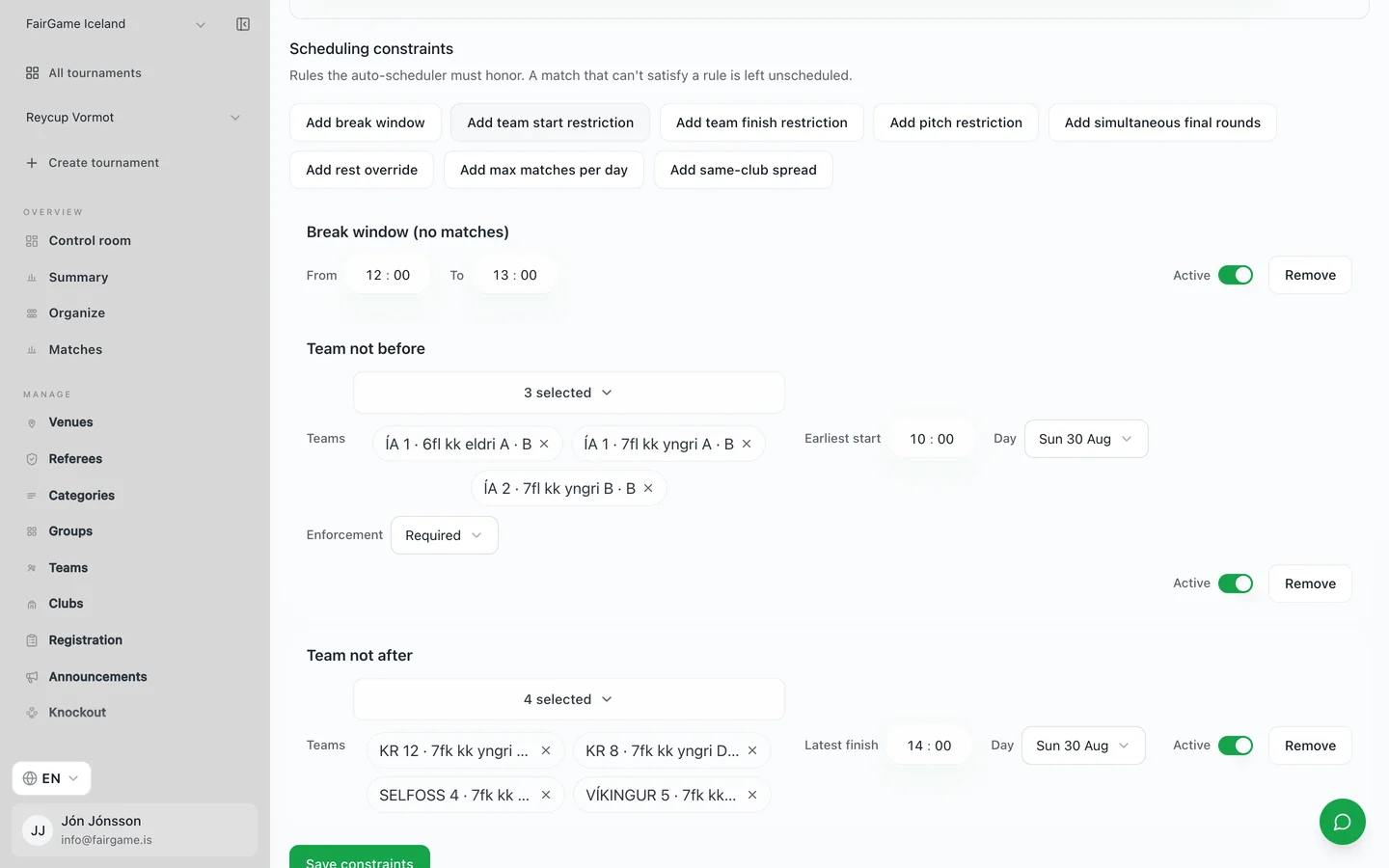
Once you are placing fixtures across several sites, the list of things that must hold gets long. These are the ones organizers hit in practice:
- Rest between matches — a minimum gap so teams are not playing back to back
- Travel windows — the transfer time between any two venues a team is scheduled at
- Arrival times — teams travelling from far away that cannot start before a given hour
- Departure ceilings — the youngest age groups that have to be finished by early afternoon
- Pitch open hours — sites that do not all open and close at the same time
- Category-to-pitch limits — small-sided age groups that can only use certain pitches
- Maximum matches per team per day — a cap so nobody plays six games
- Referee coverage — an official on every pitch for every hour it is in use
- Simultaneous final rounds — last group matches kicking off together so nobody can play for a result
Why this is not a spreadsheet problem
Any one of those rules is easy to check by hand. The difficulty is that they interact. Moving one match to fix a rest violation can push another team past its departure time, which frees a pitch that the referee rota no longer covers.
This is a constraint-satisfaction problem, and it is genuinely hard — the number of possible arrangements grows far faster than the number of matches. A human placing fixtures one at a time will find a schedule that satisfies the rule they are currently thinking about and quietly breaks two others.
The practical consequence is that manual multi-venue schedules are usually not wrong in an obvious way. They are wrong in a way you find out about at 10:40 on the Saturday.
Solve the whole day at once
The alternative is to state the rules up front and let a solver place every match simultaneously, rather than filling slots one at a time. FairGame's advanced scheduler does exactly that, using a constraint solver that considers the entire day as one problem.
Because it solves globally, it can answer a question a spreadsheet cannot: whether a valid schedule exists at all. If your constraints genuinely cannot be satisfied, it says so and explains which one is binding, with the capacity maths behind it — so you can add a pitch, extend hours, shorten matches or spread across another day before you have promised anyone a kickoff time.
Frequently asked questions
How do you schedule a tournament across multiple venues?
Check capacity first — total pitch-minutes against total match-minutes — then keep each category at a single venue where possible. Where a category must span sites, treat the travel time between them as a hard constraint on top of normal rest, so no team is scheduled at the second venue before it could physically arrive.
How much rest should teams get between matches?
For youth football, 30 minutes between matches on the same pitch is a common minimum, and more for older age groups playing longer matches. Across venues, add the full transfer time on top. The right number depends on match length and age, but it should be set as a rule the schedule must honour, not left to chance.
How many pitches do I need for my tournament?
Divide your total match-minutes by the minutes each pitch is open. For 300 matches at 30 minutes including changeover, you need 9,000 pitch-minutes; a pitch open for 8 hours provides 480, so you need at least 19 pitch-days — and more in practice, because a schedule packed to 100% capacity has no room for overruns.
What happens if the schedule does not fit?
You have four levers: add pitches, extend the hours venues are open, shorten matches, or spread the tournament across more days. A good scheduler will tell you which constraint is binding before the day rather than dropping matches silently.
Should each age group stay at one venue?
Wherever possible, yes. It removes travel from the schedule entirely, makes the day far easier for parents and coaches, and simplifies referee coverage. Only split a category across venues when pitch capacity genuinely leaves no alternative.