217 teams in one weekend, and nobody knocking on the control room door

“This system is insane!!”
Three tournaments ran on FairGame this weekend, and between them they put 217 teams on the pitch. Fylkir's Bikarmót for 6. flokkur and Fjölnir's árgangamót both played on Saturday, and Fylkir's Bikarmót for 7. flokkur plays on Sunday.
Each one runs on a different tournament system: groups where everyone plays everyone at Fylkir on Saturday, groups followed by a knockout at Fjölnir, and a Swiss pool for Fylkir's youngest players on Sunday. All three run from the same admin app, with parents and coaches following along in the FairGame app on their phones. This is what the weekend looked like from the organizers' side of the table.
Nobody came to the control room with questions
On a big youth tournament day, the control room doubles as an information desk. A coach wants to know when the next match starts, a parent cannot find pitch 9, someone needs a result from the far end of the ground. On Saturday that queue never formed.
"Nobody has come to ask us about anything. Complete peace to work, because everyone uses the app and gets notifications about everything that's happening."
Parents and coaches followed their own teams in the FairGame app. The live score sits on the match page while the match is played, a notification arrives with the final result, another if a match moves to a new time or pitch, and the organizers can reach everyone at once with an announcement. The answers people used to walk to the control room for were already on their phones.
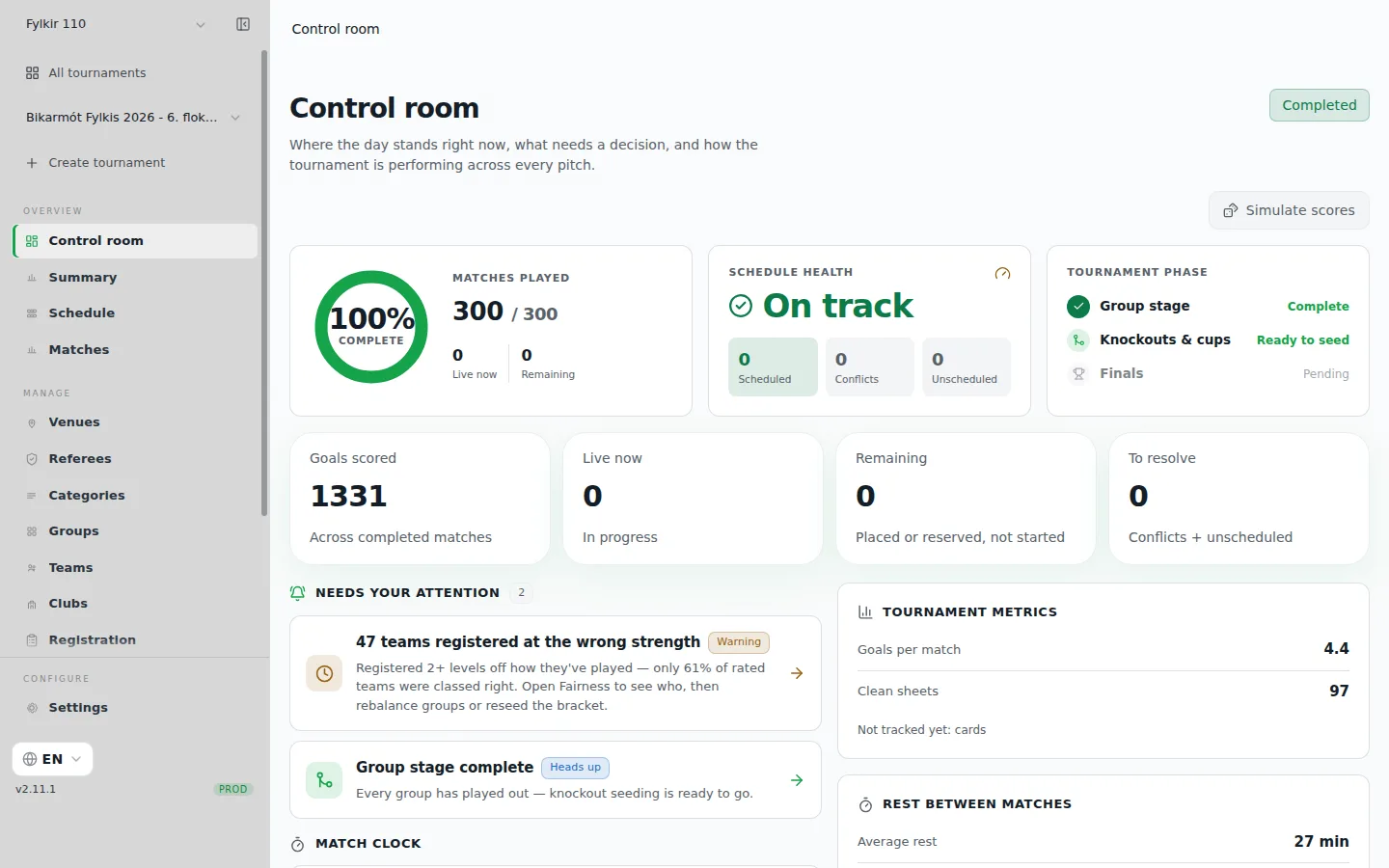
The organizers worked from a single page of their own. The Control room in the admin app shows how many matches have been played and how many are left, what is live right now, whether the schedule is running on time, and a short list of what needs a decision. With that open on the laptop, they almost never had to leave the room.
The referees scored every goal as it went in
Fylkir ran Saturday with live scoring. Nobody wrote results on a sheet and carried them to the control room. The referees had FairGame's scoring screen open on their phones and tapped a team's tile each time it scored, and every tap updated the match on the public results and in the app while it was still being played, with the group table moving along with it. When the referee submitted the final score, everyone following either team got the result as a notification. Over the day, 1,496 score updates came in from 12 pitches.
Parents noticed. As one of them put it:
"Great to see live results in the app."
Fylkir also capped the margin shown publicly at three goals, so a lopsided match between two young teams goes up as 3–0 rather than 11–0. It takes one setting, and it spares a team of children a scoreline nobody needs to see.
The little things
The organizer from Fylkir had a favourite part of the day, and it was not a big feature:
"I love the little things, like always being able to see how much of the tournament is left and how many goals have been scored."
Those are the numbers across the top of the Control room. All day they counted down the matches remaining and up the goals scored. By the end of Saturday they read 300 of 300 matches played and 1,331 goals, with a few more underneath: 4.4 goals per match, 97 clean sheets, and an average of 27 minutes' rest between a team's matches. How far along are we? One look answers it.
Finding the teams registered at the wrong strength
Before a tournament, each club registers its teams at a strength level, with 1 the strongest, and the groups are drawn from those levels. The draw is only as good as those registrations, and with 120 teams of young players, a good number of them are guesses. A team registered too weak spends the day winning 8–0, one registered too strong spends it losing 0–8, and neither is a good day for the children on it.
FairGame rates every team from its results as the day goes on, and the Fairness page puts the two numbers side by side: the strength each team was registered at, and the strength it actually played at.
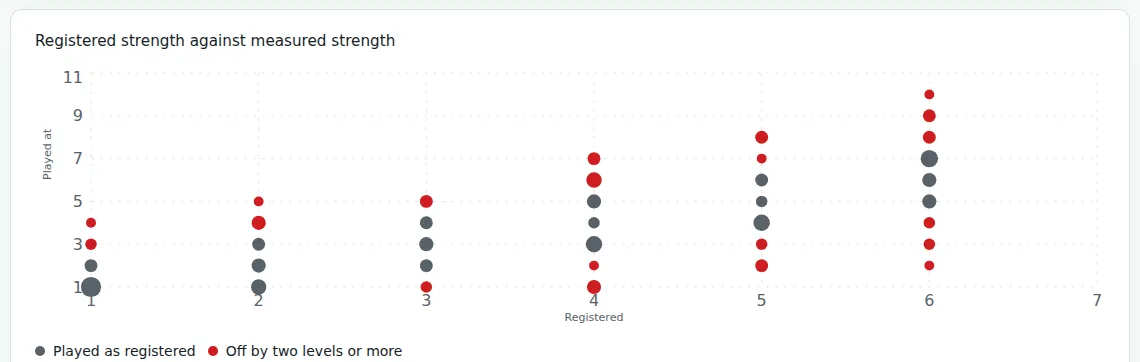
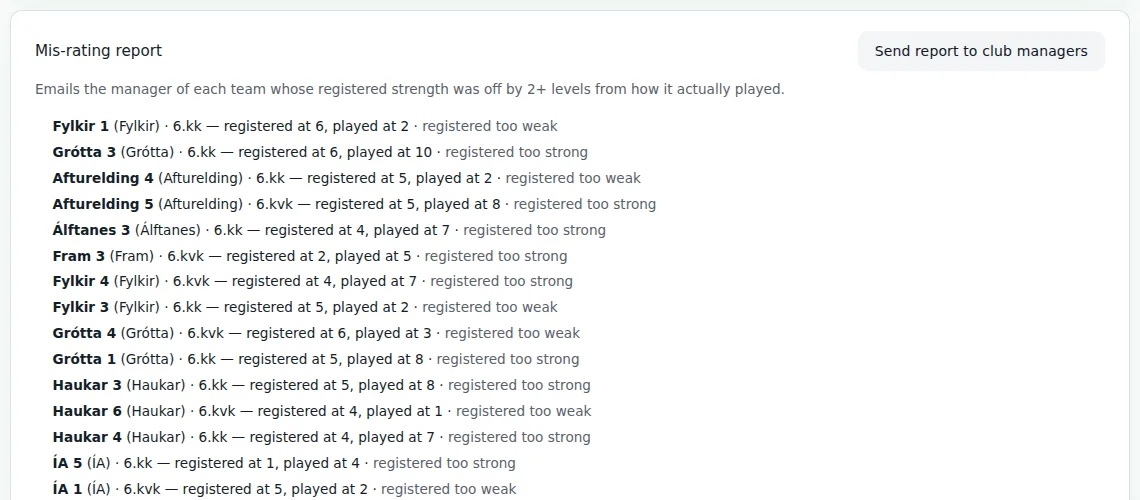
On Saturday, 47 teams ended up two or more levels away from where their club had registered them. The Control room raised it as a warning as soon as the results showed it, and the Fairness page names the teams.
"Very good to see teams that were, for example, registered at strength 4 but should have been at strength 2, and to be able to send a report straight to that coach."
That report is one button: Send report to club managers. The coach behind each flagged team gets one email covering all of their teams, with the strength each was registered at, the strength it actually played at, and a note that the numbers are a guide for the next registration, not a grade. The Club ratings table on the same page keeps each club's strength across all of an organizer's tournaments, so next year's draw can start from how a club's teams actually played instead of a fresh guess.
Three tournaments, three tournament systems
- Bikarmót Fylkis, 6. flokkur (Saturday): 120 teams from 12 clubs, boys and girls, in 20 groups of six where everyone plays everyone. 300 matches of 12 minutes on 12 pitches, kicking off between 09:00 and 15:00.
- Árgangamót Fjölnis (Saturday): 26 adult teams in three divisions (women's, younger players and veterans), a group stage followed by a knockout. 57 matches on 4 pitches between 10:00 and 13:50.
- Bikarmót Fylkis, 7. flokkur (Sunday): 71 teams from 14 clubs in a Swiss pool, where every team plays opponents close to its own strength and nobody is knocked out. 179 matches on 8 pitches, drawn before the day.
Saturday alone came to more than 350 matches and over 1,500 goals. Neither club had to fit its tournament into a format the software happened to support. Each picked the system that suited the age group, and the Control room, the scoring screen and the app work the same way whichever system is underneath.
- Round-robin vs Swiss vs knockout: which to pick
- What's New: Late September 2026, where the Swiss pool is explained
Thank you, Fylkir and Fjölnir
Two clubs, three tournaments and 217 teams, and the organizers ran it from their chairs. Thank you to everyone at Fylkir and Fjölnir who trusted us with their tournaments, to the referees who scored from the pitch, and to the parents who followed along in the app.
If you are planning a tournament this winter and want a day that runs like this one, write to us at info@fairgame.is.