What's New: Early September 2026
Our last post here was three weeks ago, on August 13th. Three weeks is not long, but FairGame looks different now: the tournament assistant we had been building quietly is ready to use, and a handful of other changes shipped alongside it.
Most of what changed under the hood is fixes and polish you would never notice. This post is about the parts that change what you can actually do: an assistant that acts on your tournament when you ask it to, a knockout bracket rebuilt from scratch, referees who cover for each other without you assigning a single shift, and a registration model that finally separates who signs up from who pays.
Tell it what you want changed. It shows you before doing it.
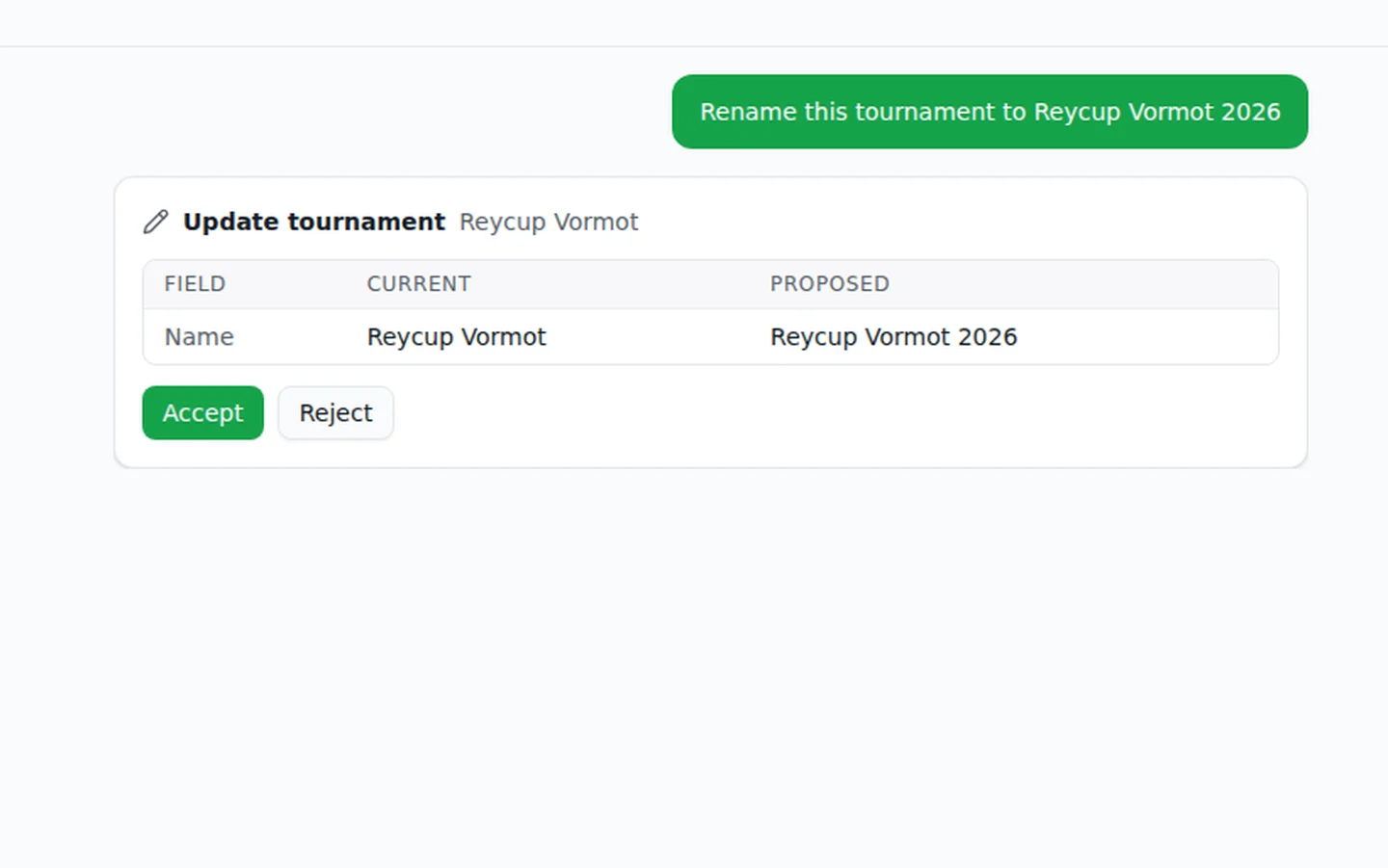
FairGame now has a chat assistant docked in the corner of every screen in the admin app. Ask it, in plain language, to enter a score, build a knockout bracket, register a team or change a setting, and it does the work — but it doesn't touch your tournament until you say so.
Every change it wants to make comes back first as a card: the field, its current value, and what the assistant proposes instead, side by side. Accept applies it, reject discards it, and there's nothing in between. Ask for something bigger, like adding eight teams at once, and the eight proposals come back together, each with its own accept or reject, so approving one doesn't force you to approve the rest.
It already covers brackets, live scoring, registration and tournament settings, and every accepted change links straight back to the page it touched. If something fails partway through, you get the failure and a retry button, not a spinner that never resolves. It's running against our own tournaments today, and we're bringing it to customers next.
The bracket got rebuilt, not just redecorated
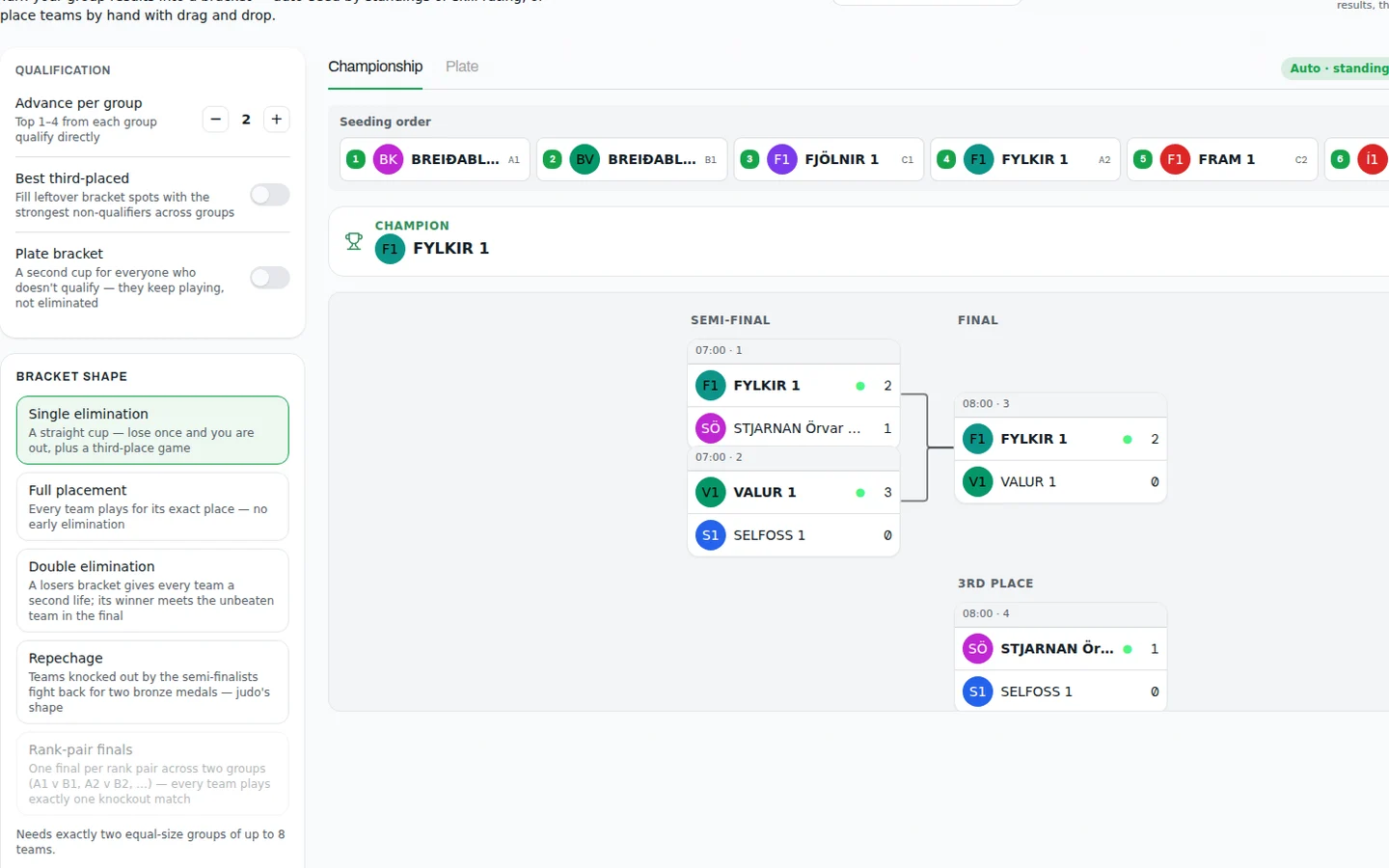
Knockout stages now render as an actual bracket: teams connected match to match by lines running through to the final and the third-place game, so you can see the whole shape of finals day at a glance instead of scrolling a stack of rounds.
Underneath that, there are more ways to run one. Single elimination still means lose once and you're out, with a third-place game alongside it. Full placement plays every team to its exact finishing position instead of sending anyone home early. Double elimination gives every team a second life in a losers' bracket, whose winner meets the unbeaten side in the final. Repechage — judo's shape — lets the teams knocked out by the semi-finalists fight back for two bronze medals. Rank-pair finals runs one final per rank across two equal-size groups, so A1 plays B1 and A2 plays B2, with every team getting exactly one knockout match. For a level final, you can now let it stand as a draw, send it to penalties, or hand the higher place to whoever had the better group-stage record.
The bracket also knows what a slot means before it's decided. A semi-final's opponent shows as “Winner of QF2” the moment the quarter-final is drawn, instead of a blank cell, so you can schedule it, assign a pitch and staff a referee before a ball is kicked in the earlier round. You can advance a winner into the next round by hand, and undo it if you get it wrong.
Referees who cover for each other, staffed automatically
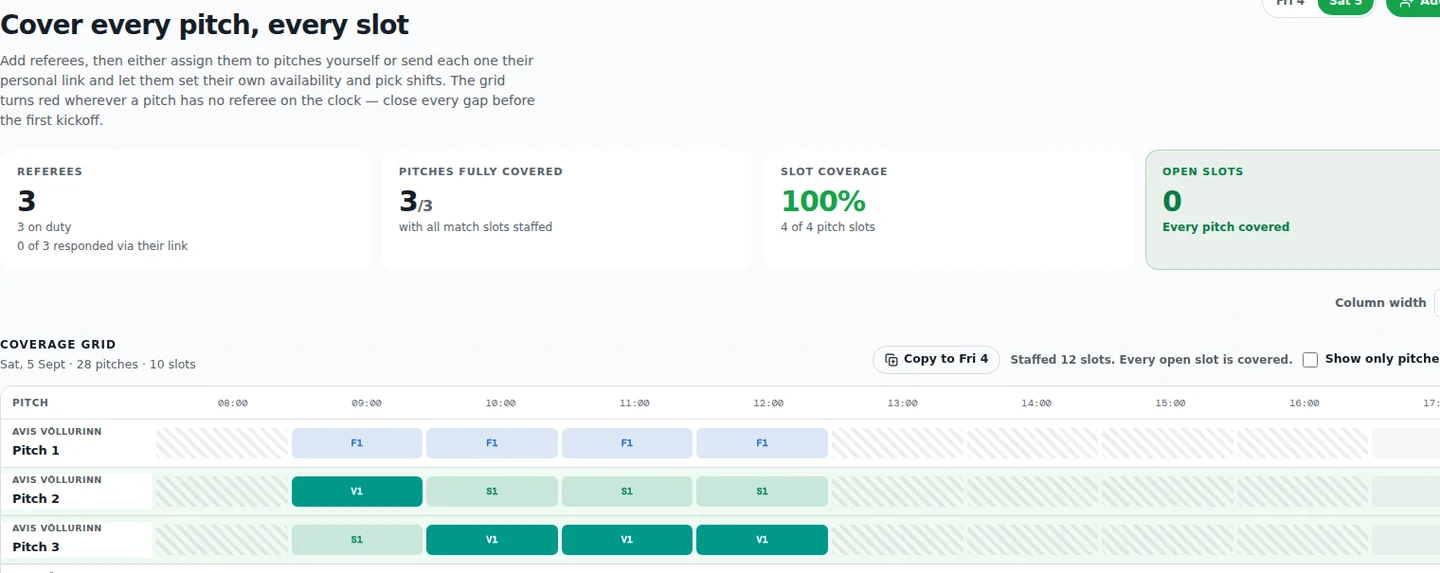
Most FairGame tournaments don't hire officials — the competing teams referee each other's matches. Auto-assign now respects that properly: it only offers a team a duty inside the hours it told you it's available, and it never books a team to referee its own kickoff.
Two rest rules keep the same team from running itself ragged. One is the familiar gap around a team's own matches; the other sits after every refereeing duty, separate from that, so a team that just finished whistling a match gets a breather before its own next game or its next duty. Auto-assign also spreads the load across the roster on purpose, so the same team doesn't end up refereeing two matches back to back just because it happened to be free both times.
Because knockout fixtures carry their placeholder opponents from the moment they're drawn, duties can be staffed for a semi-final before the quarter-finals that feed it are even played.
Clearer about who registers, and who pays
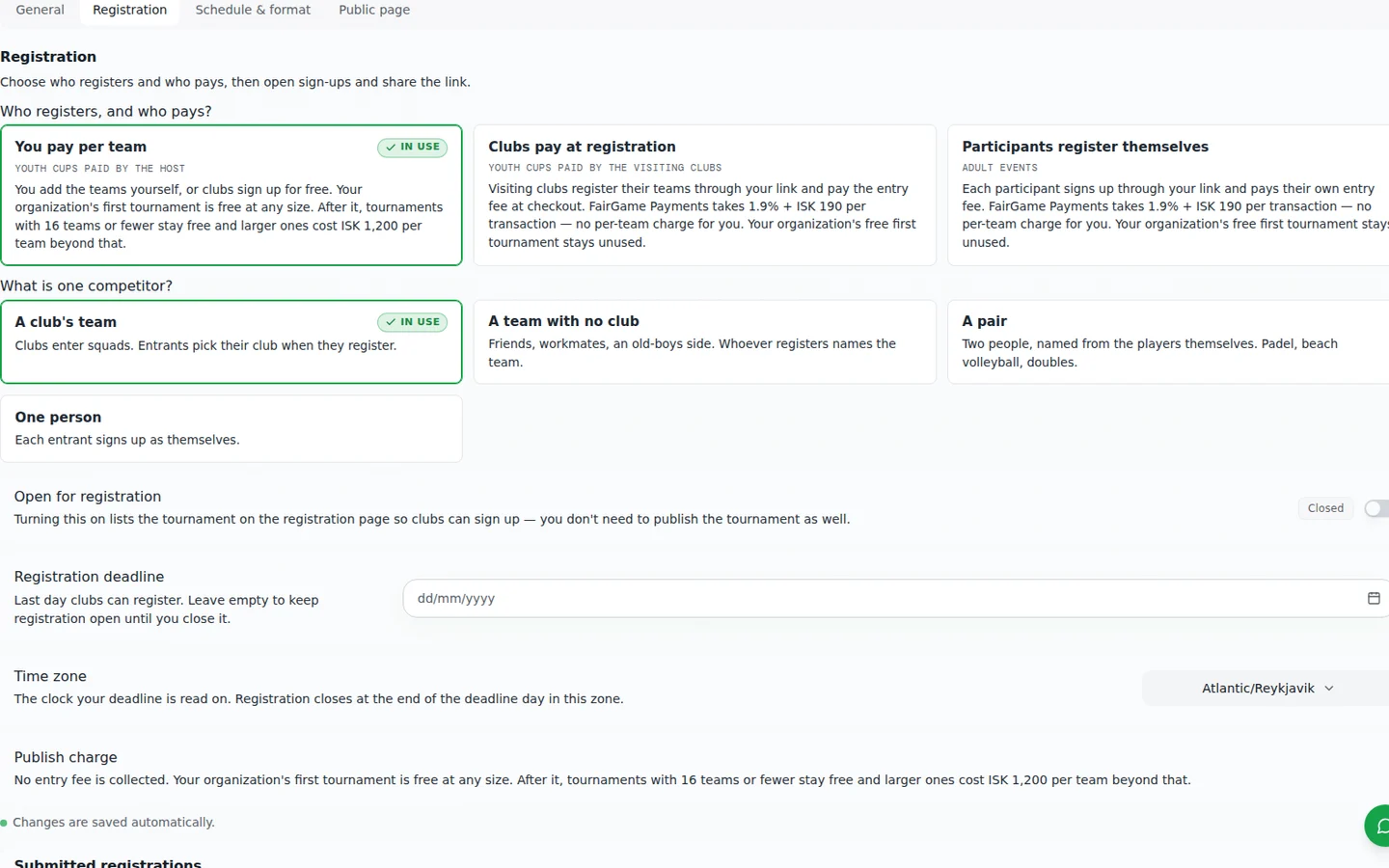
Registration settings now ask two separate questions that used to get tangled into one: who registers and pays — you, the visiting clubs, or the participants themselves — and what one competitor actually is: a club's team, a team with no club, a pair, or a single person. A youth football cup and an adult padel night need different answers to both, and FairGame no longer makes you bend one setting to cover both cases.
Where a tournament does collect fees, you can now charge once per entrant or split it per roster member, and choose whether the organizer or the payer absorbs FairGame Payments' own cut. Each competitor gets its own roster join link, so a five-a-side team can have each player pay their own share instead of one person fronting the whole entry fee.
The public side now looks like one product
The results portal and the marketing site now share one header, with the same navigation carrying a visitor from reading about FairGame straight into a live tournament. Small as that sounds, it's the difference between the results portal feeling like a different product wearing FairGame's name and feeling like FairGame.
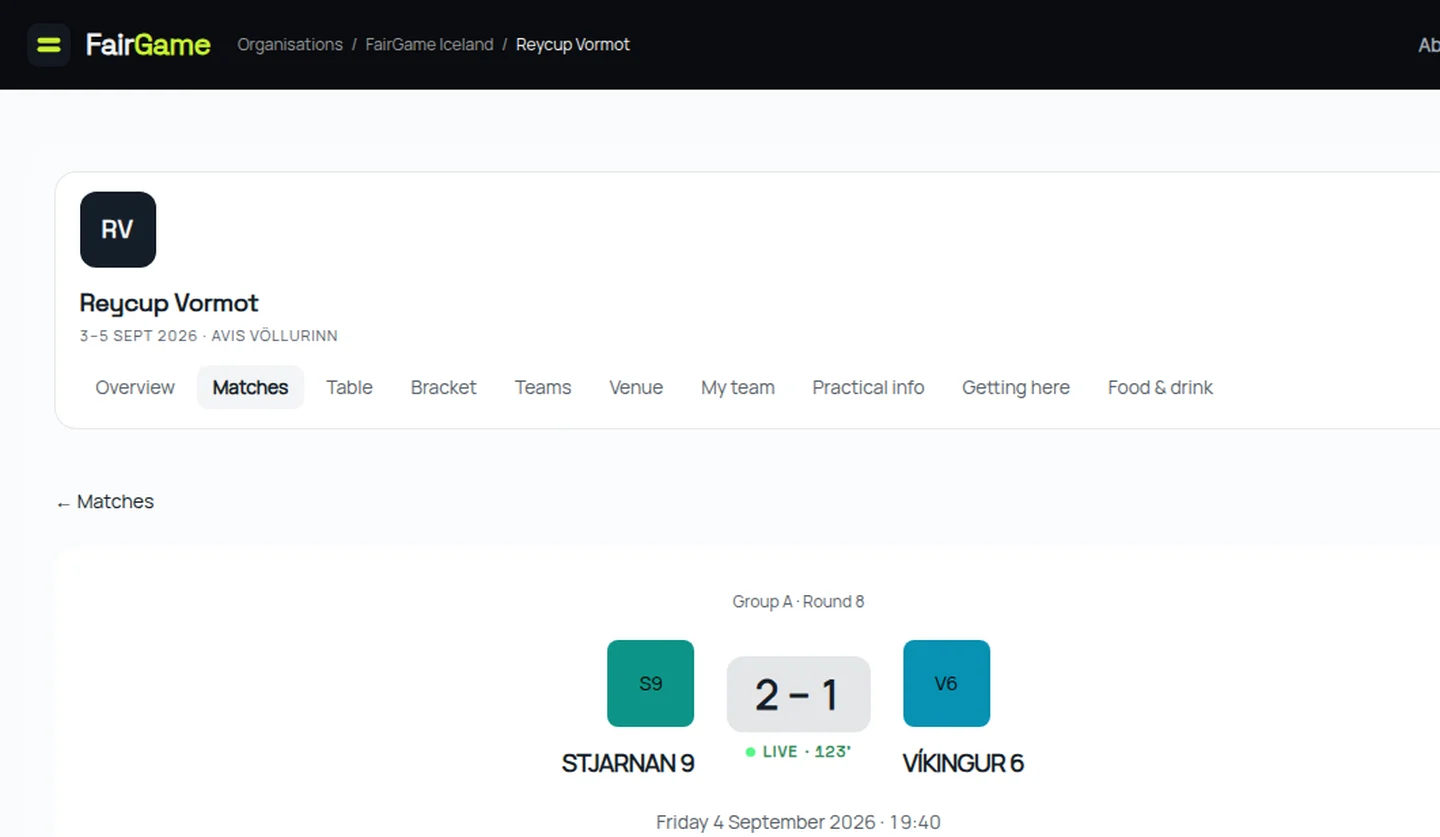
Match pages show the running minute while a game is live, not just a score. A team's own page now leads with whatever match that team is playing right now, if any, instead of making you dig for it. Cards on the Live tab show which category is playing, not just who. And if you're following a team, its group now sits at the top of the standings table instead of wherever alphabetical order happens to put it.
Smaller things that add up
- Ice hockey joins the sport roster, with IIHF's own scoring (3-2-1-0) and tiebreaker order built in, not football's rules relabeled.
- FairGame now speaks Danish, and a full accuracy pass fixed copy issues across German, French, Italian, Spanish, Finnish and Icelandic.
- Knockout fixtures can be published before the group stage finishes, so finals day is on the schedule from day one instead of appearing once qualification is decided.
- A Content-Security-Policy is now live, in report-only mode, across the admin app, the results portal and this site — the first step toward blocking the kind of injected script that policy exists to catch.
- If you missed it: we published a free, no-signup round-robin and knockout generator that runs entirely in your browser — useful on its own, and it explains the seeding and scheduling logic FairGame runs on top of.
What's next
Two threads run through everything above: work that used to be yours alone — refereeing, entering scores, building a bracket — increasingly gets done for you or by someone else on the roster, and the parts of the product that show a bracket, a live score or a registration form are converging on one consistent shape instead of three apps that happen to share a login.
Both continue. If you've tried the assistant and it almost did what you needed but not quite, or you run a format the bracket builder still can't express, we'd rather hear about it than guess — write to us at info@fairgame.is.