217 teams in one weekend, and nobody knocking on the control room door

· 8 min read

Jón Levy
FairGame
“This system is insane!!”
Ólichair of Fylkir's youth council

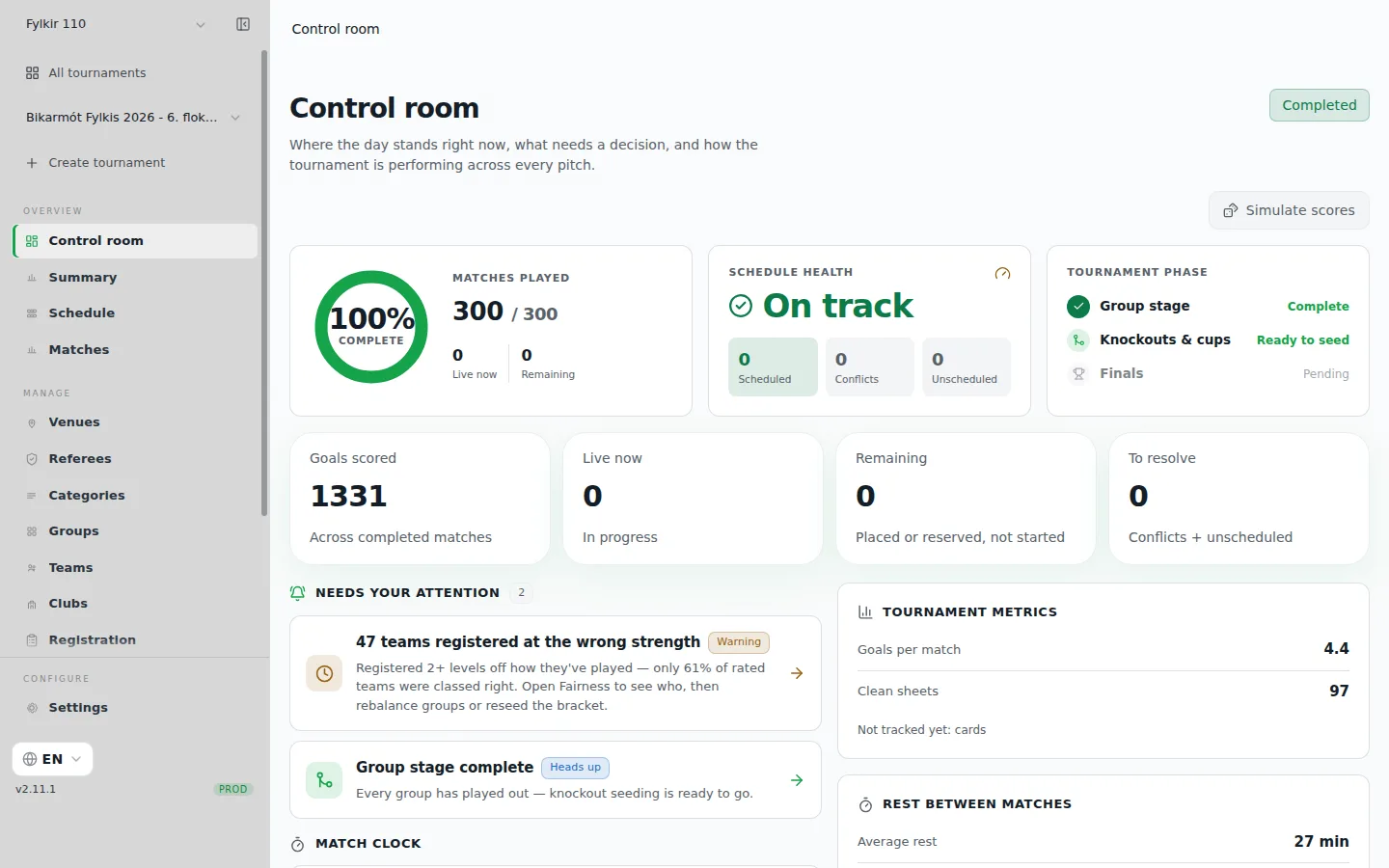
FairGame's Control room for Bikarmót Fylkis, 6. flokkur, at the end of the day: 300 of 300 matches played, none live and none remaining, 1,331 goals scored, the schedule on track, and a warning that 47 teams were registered at the wrong strength

Three tournaments ran on FairGame this weekend, and between them they put 217 teams on the pitch. Fylkir's Bikarmót for 6. flokkur and Fjölnir's árgangamót both played on Saturday, and Fylkir's Bikarmót for 7. flokkur plays on Sunday.

Each one runs on a different tournament system: groups where everyone plays everyone at Fylkir on Saturday, groups followed by a knockout at Fjölnir, and a Swiss pool for Fylkir's youngest players on Sunday. All three run from the same admin app, with parents and coaches following along in the FairGame app on their phones. This is what the weekend looked like from the organizers' side of the table.
What's New: Late September 2026

· 9 min read
Jón Levy
FairGame

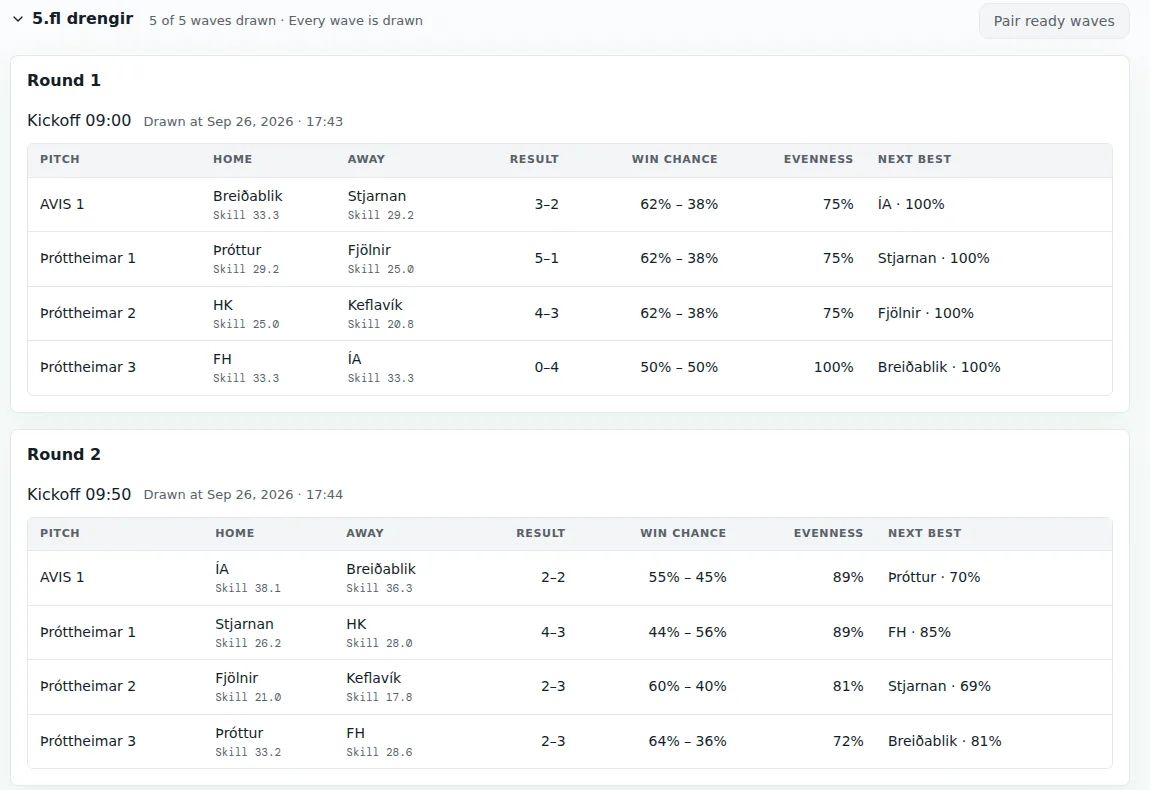
The Adaptive rounds page for a Swiss pool: round 1 paired from registered strength, round 2 paired from skill ratings recomputed after round 1, each match listed by pitch with both teams' skill, the win chance, how even the match is and the best opponent the home team did not get

Our last post was nine days ago, on September 17th, and it ended by saying the rebuilt iOS app was not something you could install yet. It is now, on iPhone and iPad, and the new Android app went out the same day.

The rest of this post covers a tournament format FairGame did not have before, the Swiss pool, which you can draw in advance or round by round as results come in; a match clock the whole hall plays to; and a setting that stops a 12–0 from being published as 12–0. A good share of the work in between is invisible, mostly release tooling for the apps, error reporting and making the admin app hold up at 512 teams, and we have left it out.

What's New: Mid-September 2026

· 7 min read
Jón Levy
FairGame

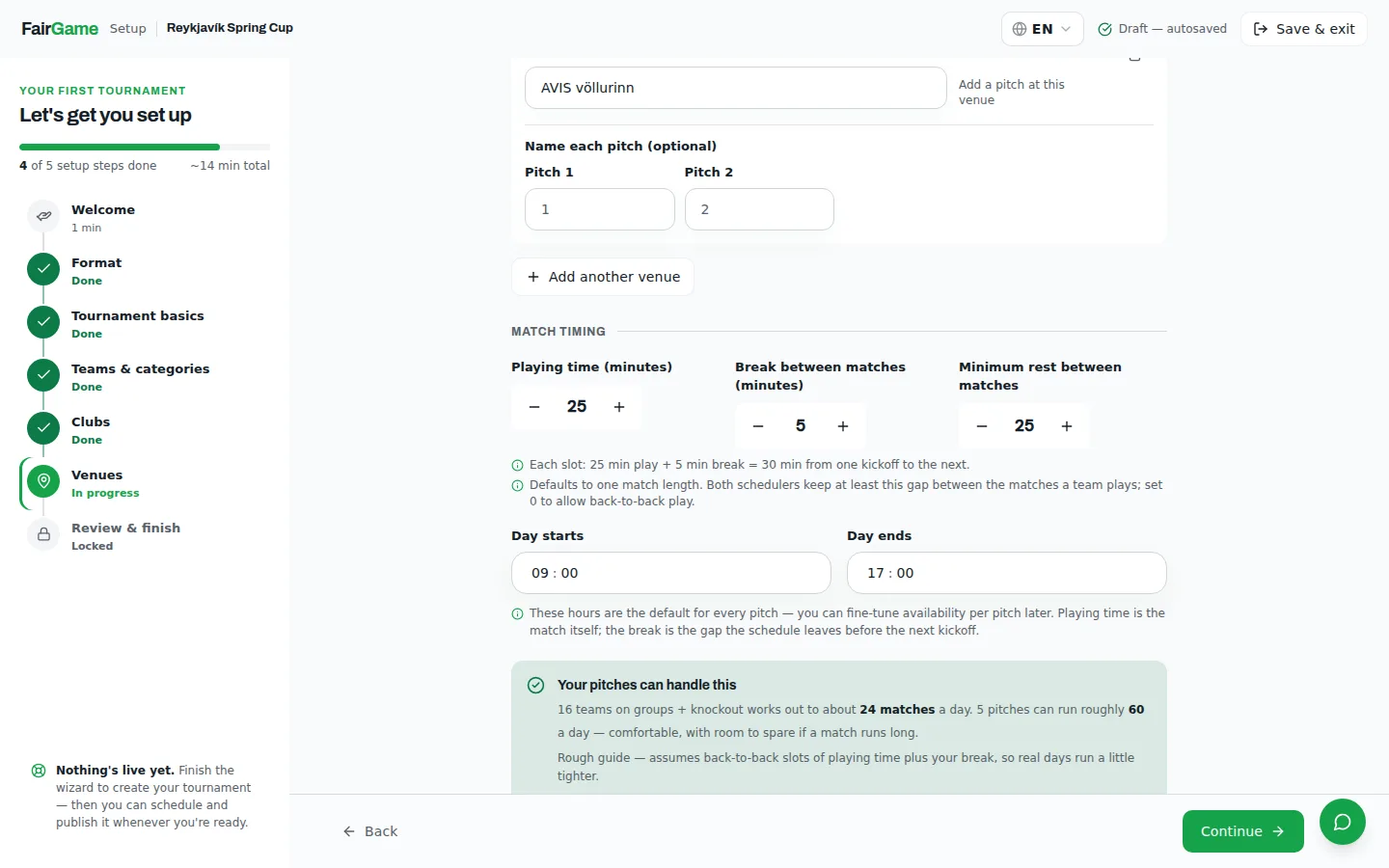
The wizard's venue step showing three separate inputs — playing time 25 minutes, break between matches 5 minutes, minimum rest between matches 25 minutes — above a green callout reading "Your pitches can handle this: 16 teams on groups + knockout works out to about 24 matches a day, 5 pitches can run roughly 60"

Our last post was two weeks ago, on September 4th. Most of what shipped since went into two things you cannot see: a native iOS app we are rebuilding from scratch and have not put in anyone's hands yet, and a long pass over error reporting so we hear about failures before you tell us about them.

What did change for organizers came mostly from one place. A club ran a real tournament on FairGame, wrote down everything that got in their way, and sent us the list. Working through it turned out to be the most useful fortnight we have had in a while, because none of it was invented by us.

What's New: Early September 2026

· 8 min read
Jón Levy
FairGame

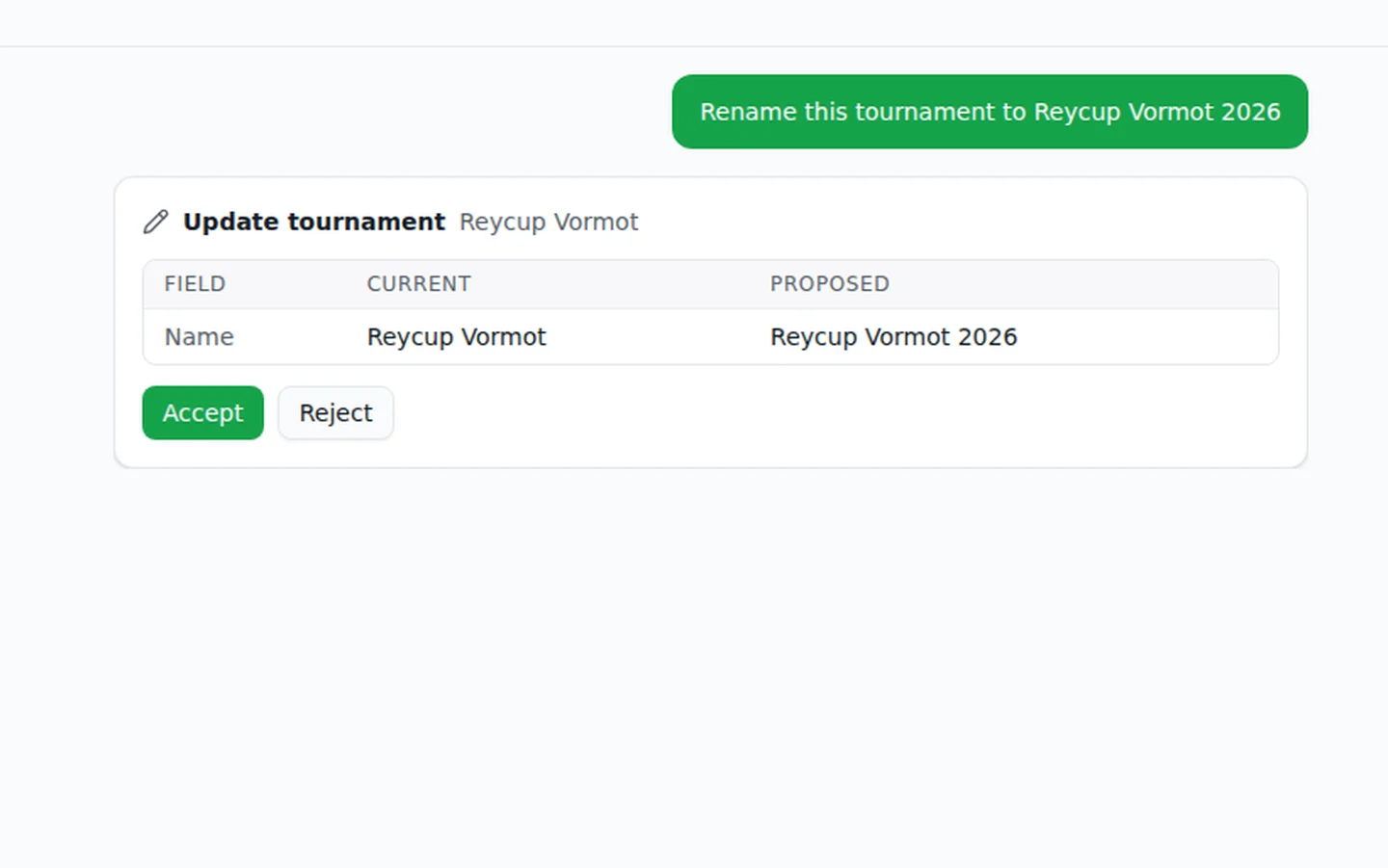
A chat message asking FairGame to rename a tournament, followed by an approval card that lists the tournament's current and proposed name with Accept and Reject buttons

Our last post here was three weeks ago, on August 13th. Three weeks is not long, but FairGame looks different now: the tournament assistant we had been building quietly is ready to use, and a handful of other changes shipped alongside it.

Most of what changed under the hood is fixes and polish you would never notice. This post is about the parts that change what you can actually do: an assistant that acts on your tournament when you ask it to, a knockout bracket rebuilt from scratch, referees who cover for each other without you assigning a single shift, and a registration model that finally separates who signs up from who pays.

Free Round-Robin and Knockout Generator

· 5 min read
Jón Levy
FairGame

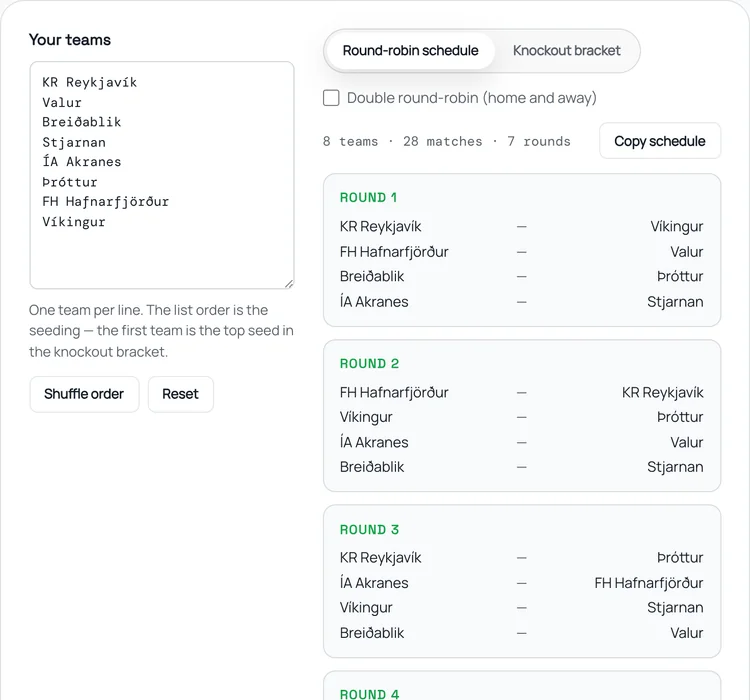
The interactive tournament generator with eight Icelandic clubs entered — the team list and seeding on the left, the generated round-robin schedule updating live on the right, with the knockout bracket one toggle away

Type in your teams and get a complete fixture list on the spot: a round-robin schedule where every team plays every other team, or a seeded knockout bracket ready for a finals day. It runs right here in the page — free, no signup, nothing to install.

Below the generator you will find a short explanation of how the fixtures are built, so you can defend the draw when a coach questions it.

How to Create a Round Robin Schedule in Excel

· 8 min read
Jón Levy
FairGame

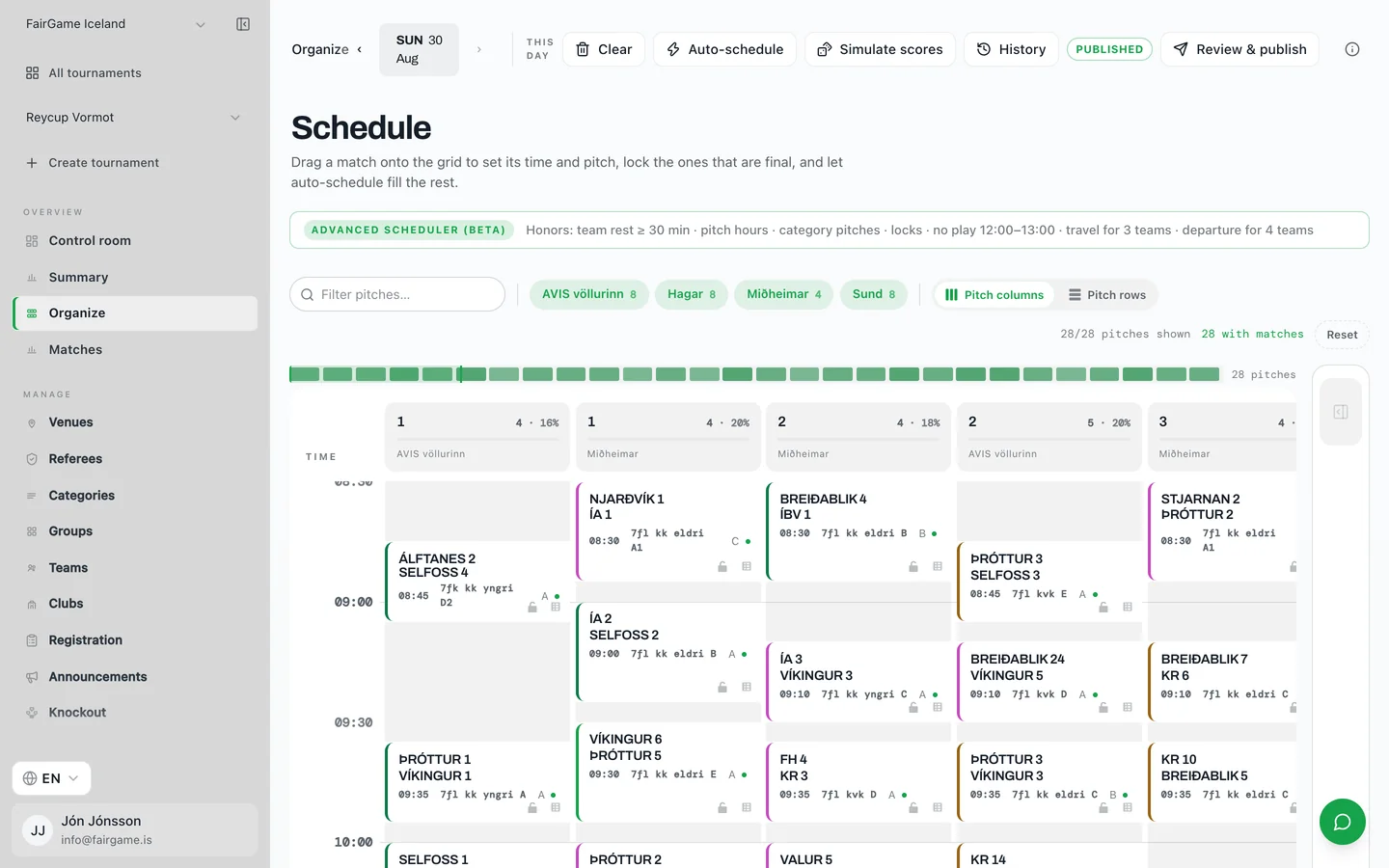
A round-robin fixture list laid out across every pitch and time slot, the finished result a spreadsheet is usually used to plan

To build a round-robin schedule in Excel, list your teams in one column, keep the first team fixed, and rotate the rest one position each round — this is the circle method, and it guarantees every team plays every other exactly once in n − 1 rounds.

Below is the manual layout, the formula that does the rotating for you, and the point at which a spreadsheet stops being the right tool.

How to Schedule a Multi-Venue Tournament

· 6 min read
Jón Levy
FairGame

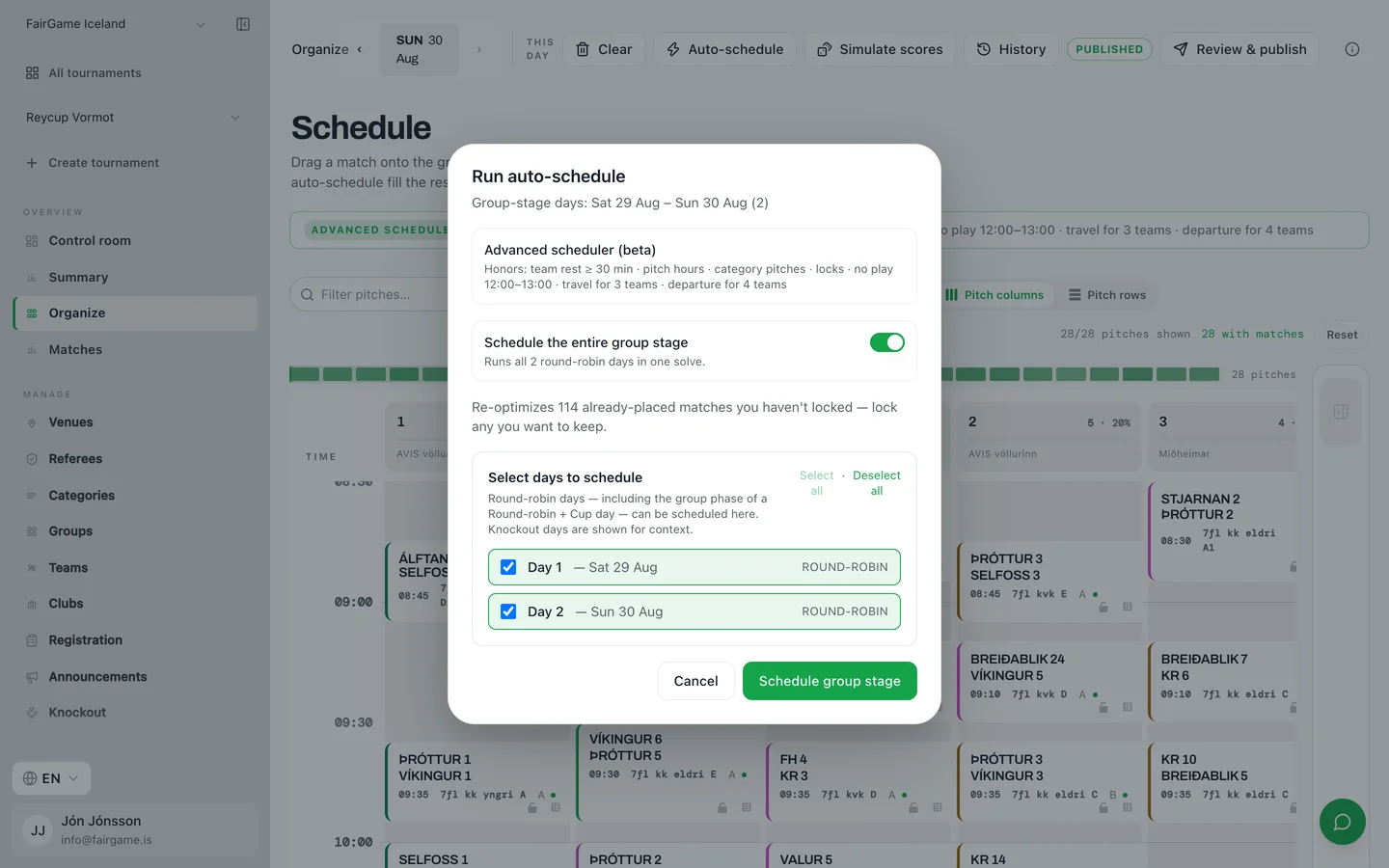
An auto-schedule dialog running the solver to place every group-stage match across both tournament days in a single solve

To schedule a tournament across multiple venues, first check the day fits at all — total pitch-minutes available against match-minutes required — then place fixtures so no team is ever booked in two places at once, and never expects a team to cross town between back-to-back matches.

The hard part is not the fixture list. It is the travel, the rest, and the fact that every constraint interacts with every other one.

Round-Robin vs Swiss vs Knockout: Which to Pick

· 7 min read
Jón Levy
FairGame

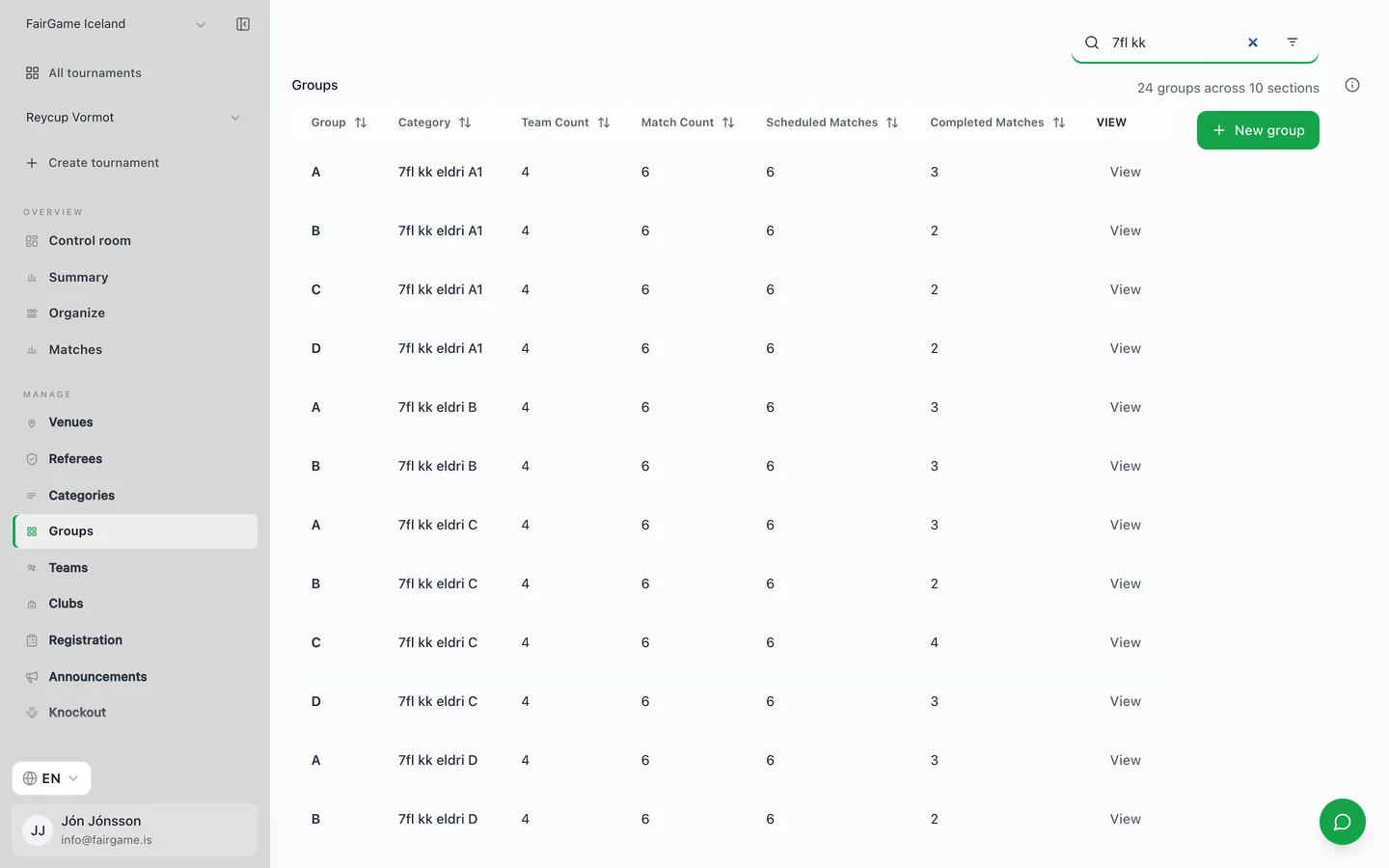
Tournament groups with teams drawn into balanced round-robin groups ahead of the knockout stage

Choose a round-robin when the field is small and fairness matters most, a knockout when the field is large and time is short, and a Swiss system when you have a large field but still want every team to play the same number of matches.

Here is how the three compare on the things that actually decide it: matches per team, total time, and how much administration they cost you on the day.

Tournament Bracket Generator: How Seeding Works

· 6 min read
Jón Levy
FairGame

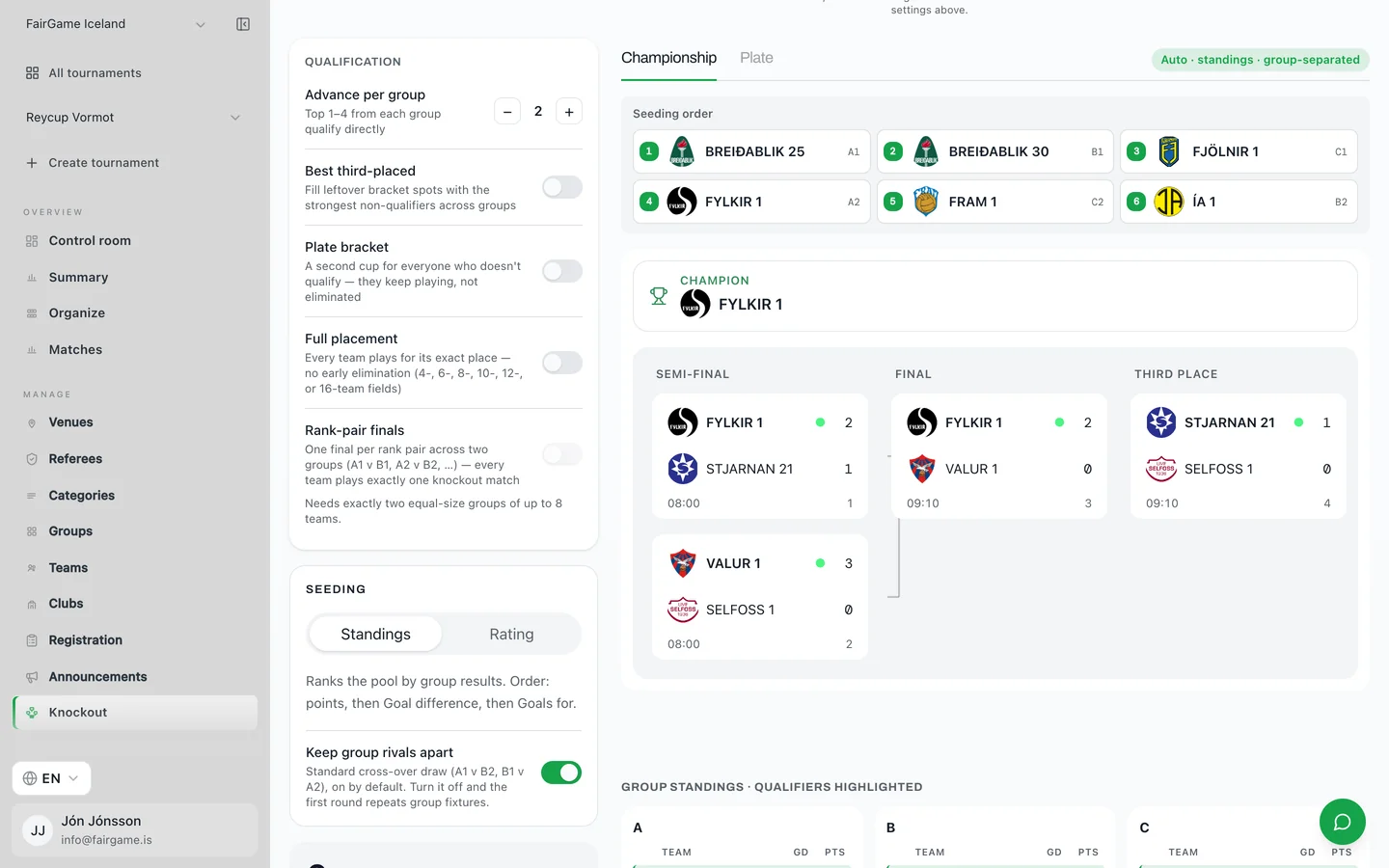
A knockout builder turning group results into a seeded bracket, with top finishers per group qualifying and seeded by their standings

A tournament bracket generator seeds teams by ranking them first, then placing them so the strongest cannot meet until the latest possible round — the top seed plays the bottom seed, the second seed plays the second-bottom, and so on down the list.

Getting that placement right is what separates a bracket that feels fair from one that produces a great final by luck.

What Are Knockout Rounds?

· 6 min read
Jón Levy
FairGame

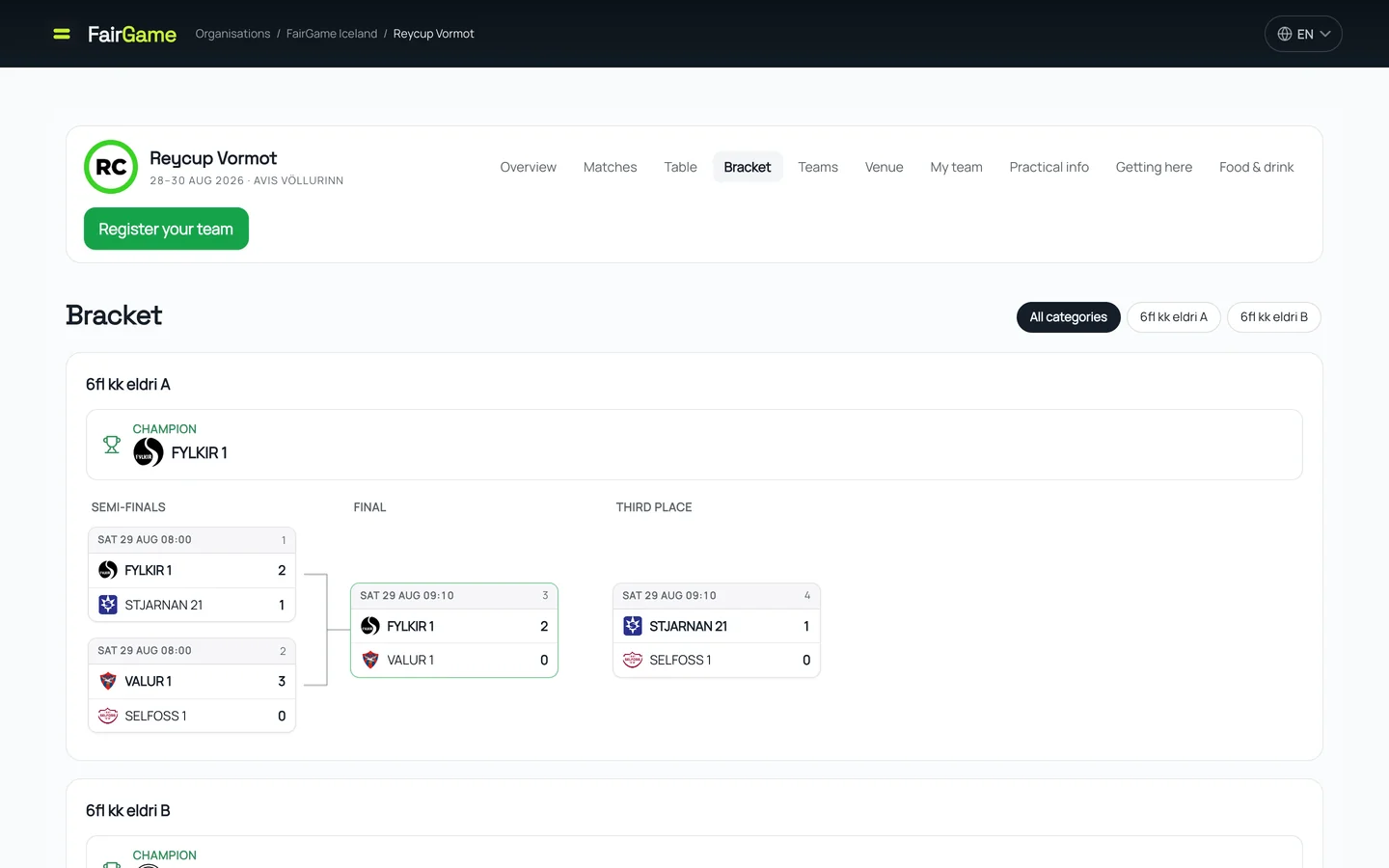
A public knockout bracket showing the semi-finals, final and third-place match with real teams advancing round by round

Knockout rounds are the stages of a tournament where the loser of each match is eliminated and the winner moves on. Each round halves the field, so 16 teams become 8, then 4, then 2, then a single champion.

They are also called elimination rounds or the bracket, and they are what most people picture when they think of a tournament finish.