What Are Knockout Rounds?
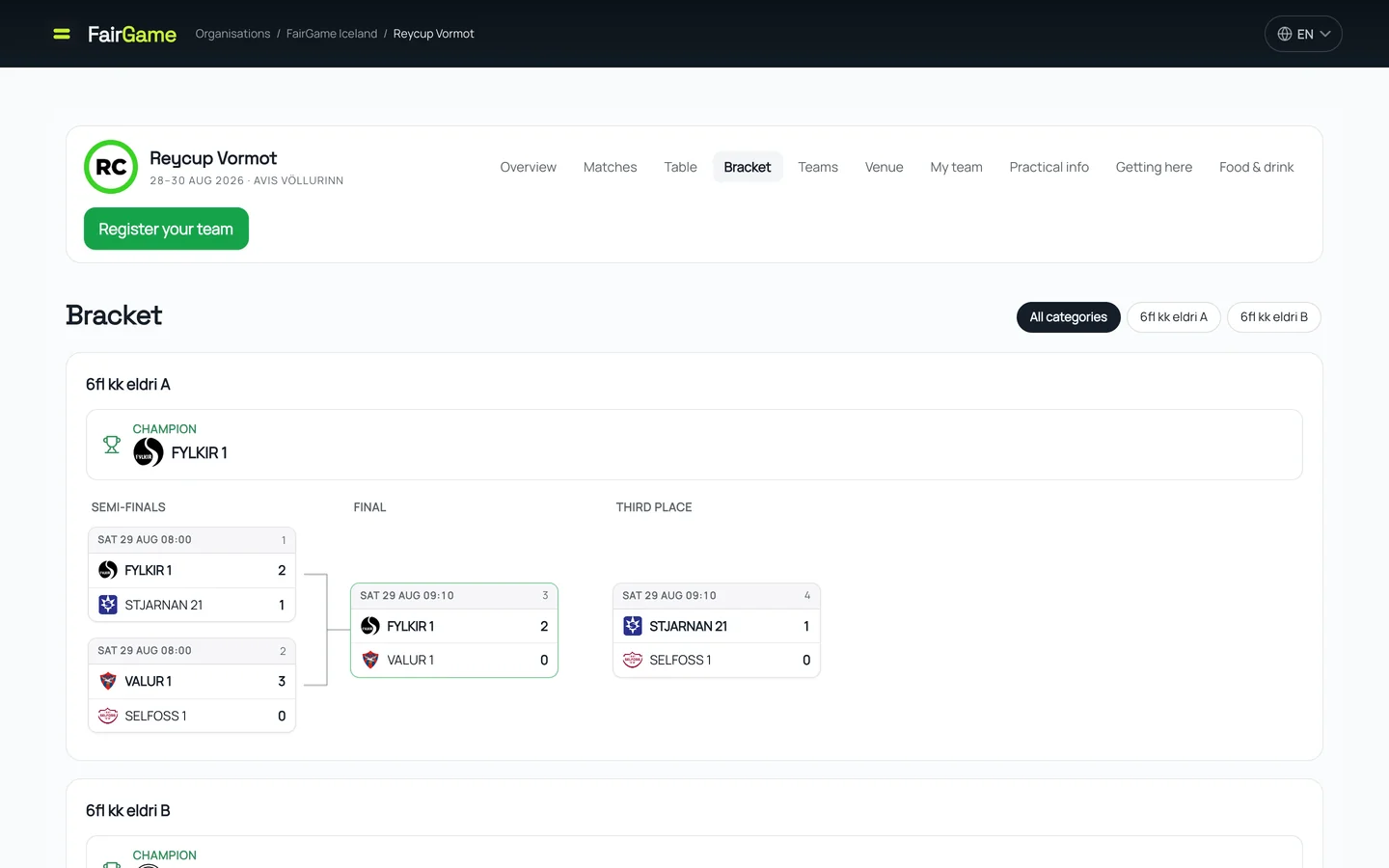
Knockout rounds are the stages of a tournament where the loser of each match is eliminated and the winner moves on. Each round halves the field, so 16 teams become 8, then 4, then 2, then a single champion.
They are also called elimination rounds or the bracket, and they are what most people picture when they think of a tournament finish.
How a knockout round works
Every team is paired with one opponent. They play once. The winner advances to the next round; the loser is out of the competition entirely. There is no table, no points, and no second chance.
Because each match removes exactly one team, a knockout needs far fewer matches than a league. Finding a champion among 16 teams takes 15 matches — one fewer than the number of teams, always.
What the rounds are called
Rounds are named after how many teams are left when the round starts, not how many matches it contains. That trips people up more than anything else in a bracket.
- Round of 32: 32 teams, 16 matches
- Round of 16: 16 teams, 8 matches
- Quarter-final: 8 teams, 4 matches
- Semi-final: 4 teams, 2 matches
- Final: 2 teams, 1 match — the winner takes the tournament
Many tournaments add a third-place match between the two beaten semi-finalists. It is optional, but it gives both teams one more game and settles the podium.
Byes: what happens when the field is not a power of two
Brackets work cleanly when the number of teams is a power of two — 4, 8, 16, 32. Real tournaments rarely cooperate. With 12 teams, a straight bracket does not divide evenly.
The fix is a bye: a team advances to the next round without playing. Byes normally go to the strongest teams, so the field is trimmed to a power of two in the first round and everything is clean from there. With 12 teams, 4 teams get a bye and the other 8 play a first round, leaving 8 for the quarter-finals.
Seeding: why the bracket is not a random draw
If you draw a bracket at random, the two best teams can meet in the first round, and one of them goes home immediately. Seeding exists to prevent that.
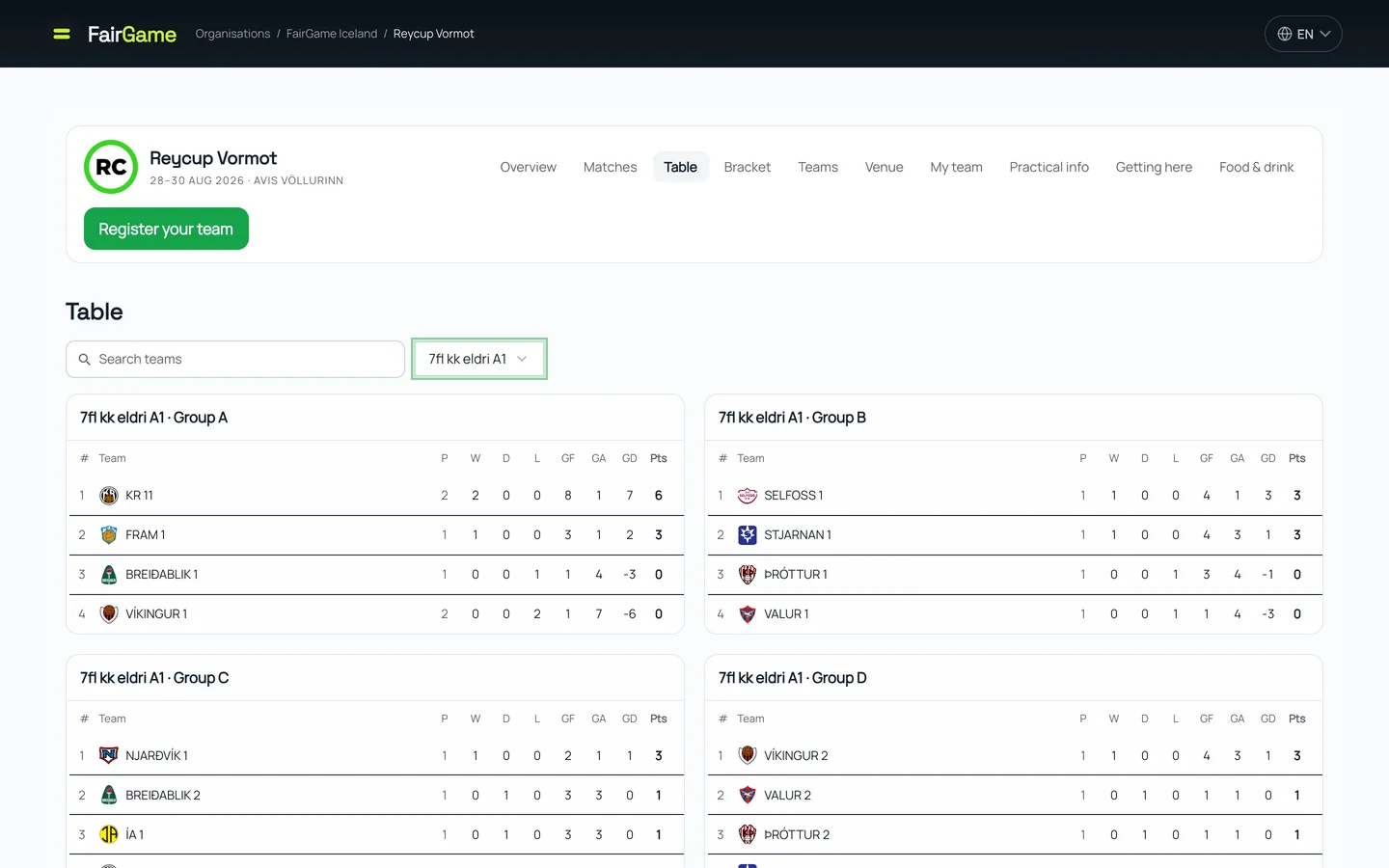
Seeding ranks teams before the draw and places them so the strongest are kept as far apart as possible — top seed and second seed can only meet in the final. In a tournament with a group stage first, the seeding usually comes from the group tables: group winners are seeded above runners-up.
When to use knockout rounds — and when not to
A knockout is the right choice when you have a large field and a hard time limit. It is decisive, it is dramatic, and it finishes on schedule.
It is the wrong choice when teams have travelled a long way for the day. Half your field is eliminated after a single match, and a team that lost narrowly to the eventual winner goes home with one game played. For youth and club tournaments that is usually unacceptable.
The common compromise is a group stage into a bracket: everyone gets three or four guaranteed matches in a small round-robin group, then the top finishers advance to knockout rounds for a decisive finish. Adding a plate bracket — a second competition for the teams that do not qualify — means nobody stops playing early.
Running the bracket without redrawing it by hand
The administrative cost of a knockout is that every result changes the next round. Someone has to know who won, work out who that puts through, and update the bracket before the next kickoff — usually while the tournament is running.
FairGame generates the bracket from your live group standings and advances teams automatically as results come in. Brackets run from a final up to a round of 32, byes are handled for you, and seeding can come from the standings, from skill rating, or from your own drag-and-drop order.
Frequently asked questions
What are knockout rounds in a tournament?
Knockout rounds are the elimination stages where the losing team is out of the tournament and the winner advances. Each round halves the number of remaining teams until a single champion is left. They are also called elimination rounds or the bracket.
How many matches are in a knockout tournament?
One fewer than the number of teams. Every match eliminates exactly one team, and all but the champion must be eliminated, so 16 teams need 15 matches. Add one more if you play a third-place match.
What is the difference between a knockout round and a group stage?
In a group stage every team plays several matches and is ranked in a table by points, so one bad result is survivable. In a knockout round a single defeat ends the tournament for that team. Many tournaments use a group stage first to guarantee matches, then knockout rounds to decide the winner.
What is a bye in a knockout bracket?
A bye lets a team advance to the next round without playing, and is used when the field is not a power of two. Byes usually go to the highest-seeded teams, trimming the field to a clean 8, 16 or 32 for the following round.
Why are knockout brackets seeded?
So the strongest teams cannot meet too early. Seeding places the top-ranked teams in opposite parts of the bracket, meaning the first and second seeds can only face each other in the final. Without it, a random draw can eliminate the two best teams in round one.