Round-Robin vs Swiss vs Knockout: Which to Pick
Choose a round-robin when the field is small and fairness matters most, a knockout when the field is large and time is short, and a Swiss system when you have a large field but still want every team to play the same number of matches.
Here is how the three compare on the things that actually decide it: matches per team, total time, and how much administration they cost you on the day.
| Round-robin | Swiss | Knockout | |
|---|---|---|---|
| Matches per team | n − 1 (most) | Fixed — you choose the rounds | 1 minimum, log₂(n) for the winner |
| Total matches (16 teams) | 120 | 40 (5 rounds) | 15 (fewest) |
| Fairness | Highest — plays everyone | High — paired by current score | Lowest — one bad game ends it |
| Schedule known in advance | Yes, in full | Only round 1 | Yes, in full |
| Best for | 4–6 teams, or a group stage | Large fields, everyone plays equally | Large fields, hard time limit |
Quick answer: round-robin for a small, fair field; knockout for a large field on a tight clock; Swiss for a large field where everyone still needs to play the same number of matches.
Round-robin: fairest, hungriest for time
Every team plays every other team. The final table is close to unarguable, because nobody's ranking depends on who they happened to draw.
The cost is volume. Match count grows with the square of the field: n × (n − 1) ÷ 2. Six teams is 15 matches, but sixteen teams is 120. That is why round-robins stay practical only for small groups — typically four to six teams — and why large tournaments use them for the group stage rather than the whole event.
- Matches per team: n − 1 — the most of any format
- Total matches: n × (n − 1) ÷ 2 — grows fastest
- Best for: 4–6 teams, or as a group stage
Knockout: fastest, most brutal
Each match eliminates a team, so finding a champion among n teams takes exactly n − 1 matches. It is by far the most time-efficient format, and the finish is dramatic.
The trade-off is that half the field is eliminated after one match. A team that travelled two hours can be finished before lunch, and a single bad game — or a tough opening draw — ends a good team's tournament.
- Matches per team: 1 at minimum, log₂(n) for the winner
- Total matches: n − 1 — the fewest of any format
- Best for: large fields with a hard time limit
Swiss: the middle ground most organizers have not tried
A Swiss system fixes a number of rounds up front — say five — and every team plays in all of them. Nobody is eliminated.
What makes it Swiss is the pairing rule: after each round, teams are paired against opponents on a similar score. Winners play winners, losers play losers. So the undefeated teams meet each other naturally as the tournament progresses, and by the final round the top pairing is usually a de facto final — without anyone having been knocked out.
The appeal is the ratio. With 32 teams, five Swiss rounds gives every team five matches for 80 matches total. A full round-robin would need 496. A knockout would find a winner in 31 but send half the field home after one game.
- Matches per team: fixed and equal — you choose the number of rounds
- Total matches: rounds × n ÷ 2 — grows linearly, not quadratically
- Best for: large fields where everyone must play the same amount
The catch is administration. Pairings for round three cannot be produced until round two is scored, so the schedule cannot be published in full in advance — awkward when parents want the day's timings on the Monday. Swiss also needs a rule preventing rematches, and a tie-break system for teams finishing on equal scores.
Group stage into a bracket: what most tournaments actually use
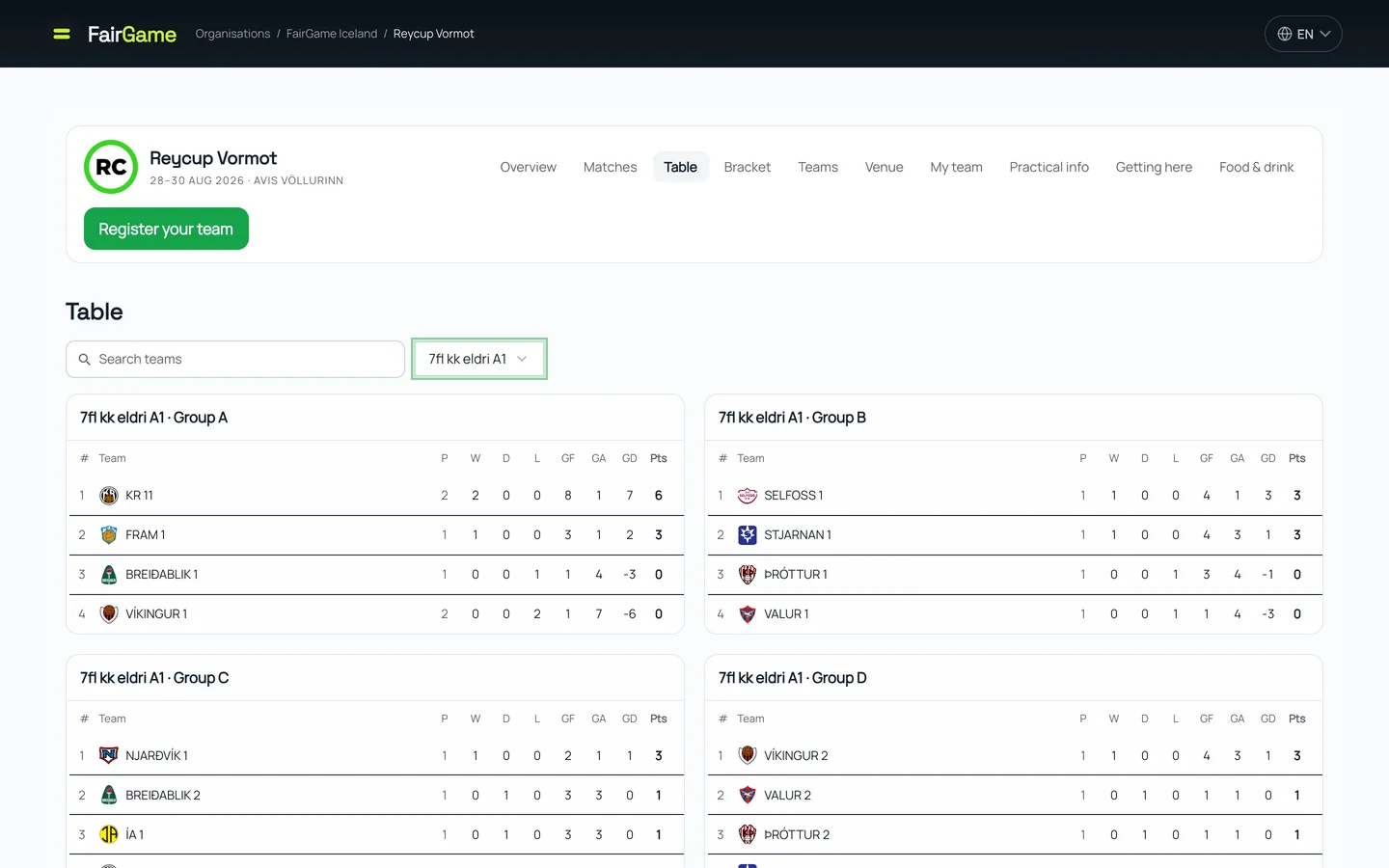
The default for youth and club tournaments is a hybrid: small round-robin groups first, then a knockout for the top finishers.
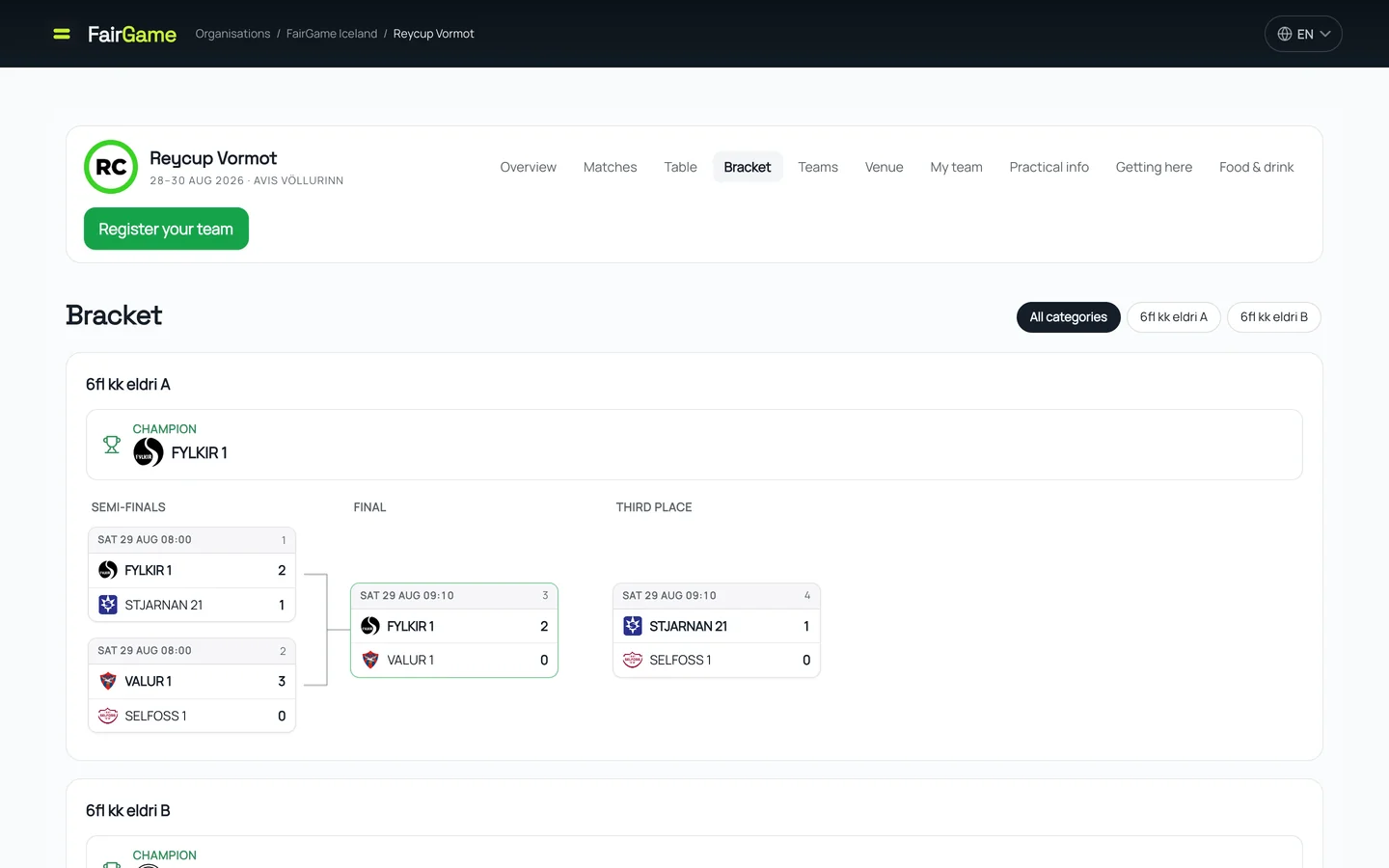
It gets you the best of both. Every team is guaranteed three or four matches regardless of results, the group tables produce a defensible seeding for the bracket, and the tournament still ends with a real final. Adding a plate bracket for the non-qualifiers means nobody's day ends early.
A rule of thumb
Match the format to your binding constraint:
- Fewer than 6 teams, fairness matters most: single round-robin
- Large field, hard time limit, decisive result needed: knockout
- Large field, everyone must play the same number of matches: Swiss
- Guaranteed matches plus a real winner: groups into a bracket
- Small field but you dislike one-and-done: double elimination
Modelling the options before you commit
The decision is easier when you can see what each format costs in hours. Work out the match count for two or three candidates, divide by the pitch-minutes you have, and you will usually find the choice makes itself.
In FairGame the format is a setting rather than a commitment. Pick round-robin, knockout, or groups into a bracket per tournament day, and the schedule, standings and brackets regenerate automatically — so you can model a couple of options and compare match count and finish time before you announce anything.
Frequently asked questions
What is a Swiss system tournament?
A format with a fixed number of rounds where nobody is eliminated and teams are paired each round against opponents on a similar score. Winners meet winners, so the strongest teams converge naturally, and every team plays the same number of matches.
Is Swiss better than a round-robin?
For large fields, usually yes on efficiency. With 32 teams a five-round Swiss needs 80 matches against 496 for a full round-robin, and every team still plays five times. A round-robin remains fairer in the strict sense, because Swiss rankings depend partly on who you were paired against.
How many matches does each format need?
Round-robin: n × (n − 1) ÷ 2. Knockout: n − 1. Swiss: rounds × n ÷ 2. For 16 teams that is 120, 15, and 40 for a five-round Swiss.
Which tournament format is best for youth football?
Group stage into a bracket, in most cases. It guarantees every team several matches so nobody travels for a single game, produces a defensible seeding from the group tables, and still finishes with a real final. A plate bracket for non-qualifiers keeps every team playing.
Can you publish a Swiss schedule in advance?
Not in full. Each round's pairings depend on the previous round's results, so only the first round can be published ahead of the day. If parents and coaches need complete timings in advance, a group stage into a bracket is the easier choice.