Team strength and fairness
The Fairness overview puts draw balance, shortest rest, longest wait and group-stage finish first, followed by group and team-strength tables. A dash means a value is unavailable; unrated teams never produce a perfect headline score. Provisional ratings and unreliable registration warnings stay visible. Open Draw fairness, Rating history, Team ratings or Club ratings for supporting details and charts. Recompute remains in the page header, and the mis-rating report keeps its separate confirmation.
Every team carries a strength — 1 is strongest, higher numbers are weaker. Organizers usually rate 1–5 by hand; an imported roster keeps whatever scale it arrived with. It is optional, and leaving everything at 3 is a legitimate choice.
FairGame uses it twice: to draw the groups, and to seed the initial ratings. How the draw uses it depends on where the groups are made — the setup wizard puts teams of similar strength together, while splitting a category into groups later spreads the strongest apart; categories and groups explains both. Most of the Tools → Fairness page is about the gap between that guess and what actually happened.
Registered strength versus measured strength
Once matches have been played, Recompute ratings learns each team's real skill from the results. The scatter plot then puts the two side by side: registered strength on one axis, the strength the team actually played at on the other.
A team on the diagonal played as registered. Below it, it played stronger than registered; above it, weaker. Teams off by two levels or more are flagged — those are the ones that made somebody's Saturday miserable. The measured strength stays on the scale the category uses: in a category registered 1–6, a team that lost every match played at 6, not 8, so a team registered at the weakest level is never flagged as registered too strong.
The rating is OpenSkill: a skill number with a confidence band that narrows as a team plays more. Higher is stronger. It is the same number the knockout seeding uses when you seed by skill rather than standings, and it fills in only once a team has played.
Rating history charts one team's skill across the tournament, with the band showing the range it is likely in. A team with one result gets a point rather than a line.
Draw fairness
A score out of 100 for how balanced your fixtures are. 100 means every fixture looks like a close game; a lower score means lopsided matchups, and the page lists the likely blowouts with the favourite's win probability.
Read the basis line before you act on the number. Early in a tournament most fixtures are between teams that have not played each other yet, so the score is predicted from registered strengths — and if several of those registrations have already proven wrong, predictions built on them are not worth much. The page says so, and badges the score Provisional.
A low score is actionable: reseed the bracket, or rebalance the groups, and recompute.
Schedule quality
The Schedule quality panel at the top of the page reads the group-stage schedule as it stands — the matches you or auto-schedule have placed — and reports what teams will actually live through. It is there as soon as the tournament has group matches; until any are placed it asks you to run auto-schedule first.
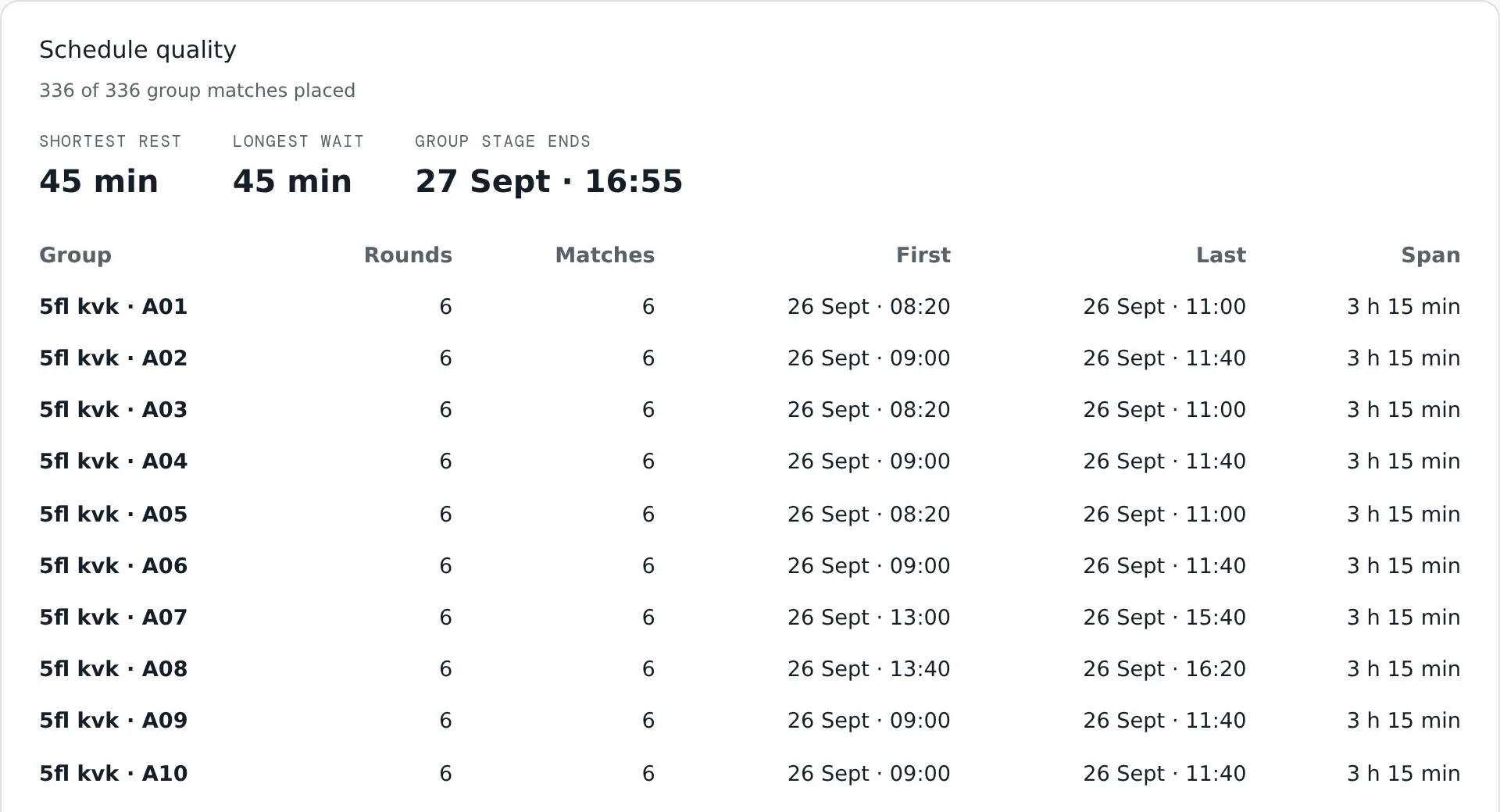
- The line under the title — for example 42 of 48 group matches placed — says how complete the schedule is, and how many groups have nothing placed yet.
- Shortest rest — the shortest time any team gets between the end of one match and the start of its next.
- Longest wait — the longest any team sits idle between two matches.
- Group stage ends — when the last placed group match finishes.
Below the figures, a table gives each group's Rounds, Matches, First and Last kick-off and Span — from its first kick-off to the end of its last match. A group whose span is far longer than the others' is a group whose teams hang around all day. The last line shows each pitch's load: how many matches it hosts and when it is done.
Read it after every auto-schedule run. A shortest rest below your rest rule, or one pitch finishing hours after the rest, is the place to start editing the schedule.
The mis-rating report
Send report to coaches emails each team whose registered strength was off by two or more levels from how it played — the team's Contact email and its club's Club contact email (see teams and clubs). Someone who is the contact for several flagged teams gets one email that lists them all. No one else is contacted, and the page tells you how many teams are flagged before you send; flagged teams with neither contact are skipped. The email is written in the language you use FairGame in (see languages). The result appears right under the button: how many recipients were emailed and, when some flagged teams had no team or club contact, how many of them heard nothing. If none of the flagged teams or their clubs has a contact email, nothing is sent and the page says so: add one to the team or the club, then send again.
This is the quiet fix for next year's tournament. A club that registers its second team as a 2 every season, and watches it lose 9–0 every season, is not being difficult — nobody ever told them. One email after the tournament is worth more than any amount of manual group rebalancing during it.
Club ratings
Strength carried across every tournament a club has played, rather than starting each edition from a fresh guess. Seed future events from this table.
It builds up over time, so an organization's first tournament shows nothing. By the third it is the most reliable input you have.
The rating is what the knockout seeds from, and it only reflects results that were loaded when you last recomputed. Run it after the group stage finishes and before you generate the bracket, or you will seed from yesterday's picture.